1

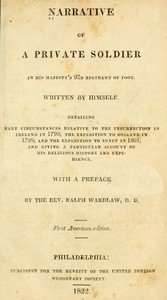
Narrative of a Private Soldier in His Majesty's 92d Regiment of Foot — Background and Themes
(0 User reviews)
1322
Project Gutenberg
2021
Not confirmed
Soldiers -- Biography; Soldiers -- Religious life; Great Britain -- History, Military -- 1789-1820
Readers of public-domain and historical texts
Project Gutenberg digital edition
en
Edition facts
Words
65,145
Reading time
284 min
Text sections
15
This digital edition of Narrative of a Private Soldier in His Majesty's 92d Regiment of Foot — Background and Themes is described by source-level measurements including 65,145 words, 4 hr 44 min estimated reading time, and 15 detected text sections.
The text analysis averages about 30.3 words per sentence, while the detected sections provide another way to judge how the source is divided.
Project Gutenberg metadata also associates the work with “Soldiers -- Biography,” connecting these edition facts with the source record’s subject description.
Source:
Project Gutenberg record #66990
A private soldier's firsthand account of the 1798 Irish Rebellion, the 1799 Holland expedition, and the 1801 Egyptian campaign, interwoven with his religious conversion and spiritual reflections, as edited by Rev. Ralph Wardlaw.
Read the complete public-domain text at its original source.
Read on Project GutenbergGeorge Billany, a private in the 92d Regiment of Foot, recounts his military service across three campaigns—Ireland in 1798, Holland in 1799, and Egypt in 1801—alongside a detailed account of his religious awakening. The narrative, published in 1822 with a preface by Rev. Ralph Wardlaw, is framed as both a historical record and a spiritual testimony. Billany’s voice is notably direct and observational, as when he describes landing in Egypt: “with a leap I landed dry shod.” The text is structured to alternate between battle scenes and introspective passages, reflecting the dual purpose of documenting external events and internal transformation.
A Soldier’s Eye on the Landing at Aboukir
Billany’s account of the Egyptian landing on March 8, 1801, is rich with tactical detail and personal observation. He notes the 42d regiment charging up a height, the enemy cavalry charging into the water, and the swift clearance of the beach “in less than a quarter of an hour.” His attention to logistics—boats hoisting sails to fetch the second division, artillery drawn by seamen—reveals a shrewd understanding of military operations. The casualty figures he provides (749 total) suggest access to official reports or a careful memory. Yet his perspective remains that of a private: he notes the broken oar in his own boat, the dead Frenchmen “within the edge of the water,” and the surprising ease of obtaining water by digging in the sand. This blend of grand strategy and ground-level detail gives the narrative a particular credibility, as Wardlaw notes in his preface, calling it “a plain unvarnished tale.”
The Religious Frame: Conversion and Conscience
Wardlaw’s preface alerts readers that Billany’s religious experience is “especially instructive,” and the excerpts confirm a sustained spiritual thread. Billany describes a “sensible and thoughtful mind” grappling with convictions that “had never entirely lost their early impressions.” The narrative is structured to show how military life and moral reflection intersect: the same man who records the chaos of battle also examines his own conscience. Wardlaw, who knew Billany as a member of his church since 1803, vouches for the honesty of this account, though he acknowledges a personal interest. The religious passages are not merely appended but integrated, suggesting that Billany saw his soldiering and his faith as mutually illuminating. Readers should expect the text to move between these registers without abrupt shifts, as the author treats both with equal seriousness.
Catalog Categories vs. Actual Content
The Project Gutenberg record classifies this work under “Adventure & Picaresque Fiction,” yet the excerpts reveal a nonfictional memoir with a strong religious dimension. The catalog subjects include “Soldiers -- Biography” and “Soldiers -- Religious life,” which align better with the text, but the “Adventure” label may mislead. Billany’s narrative is not picaresque—it lacks a roguish protagonist or episodic humor. Instead, it is a sober, chronological account of campaigns and conversion. The “History, Military” subject is apt, but the religious content is more central than the catalog suggests. Readers seeking pure military history will find substantial battle descriptions, but they will also encounter extended spiritual reflection. The work is best understood as a hybrid: a soldier’s memoir shaped by evangelical publishing aims, as indicated by its original publication “for the benefit of the United Foreign Missionary Society.”
Billany’s narrative rewards readers who appreciate firsthand military detail and are open to its devotional framework. The text is best approached as a period document that reveals how one soldier made sense of war through faith. Pay attention to the shifts between action and introspection—they are the book’s structural logic. The preface by Wardlaw provides essential context, but Billany’s own voice, with its plainness and precision, carries the work.
That rainy afternoon, the private’s quiet faith amid carnage stayed with me long after I closed the book. His steady, unadorned account made me wonder how other soldiers endured such chaos. Later, almost without thinking, I found myself looking into mounted troops’ training, picking up German Influence on British Cavalry — Story, Setting & Ideas for a glimpse of that same stubborn discipline, seen from the saddle.
There are no reviews for this eBook.
There are no comments for this eBook.
Reader reflection
How will you remember this book?
Save your reaction, strongest insight, and memorable passage.
Your progress
0
/
10
2
How did the book work for you overall?
3
Would you pass this book on to a friend?
4
What was the reading difficulty like?
5
Would this book work well in a reading group?
6
How well did it match your expectations?
7
Could you see yourself revisiting this book?
8
How clearly were the main ideas presented?
9
Which lesson or insight stayed with you?
10