1

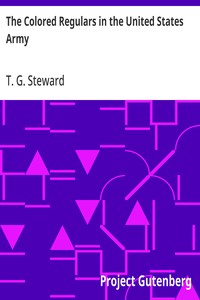
The Colored Regulars in the United States Army — Context and Discussion
(0 User reviews)
2334
Project Gutenberg
2005
Not confirmed
African American soldiers; Spanish-American War, 1898 -- Participation, African American
Readers of public-domain and historical texts
Project Gutenberg digital edition
en
Edition facts
Words
112,411
Reading time
489 min
Text sections
12
The source record for The Colored Regulars in the United States Army — Context and Discussion measures this digital text at 112,411 words, 8 hr 9 min estimated reading time, and 12 detected text sections.
The text analysis averages about 24.8 words per sentence, while the detected sections provide another way to judge how the source is divided.
Project Gutenberg metadata also associates the work with “African American soldiers,” connecting these edition facts with the source record’s subject description.
Source:
Project Gutenberg record #16750
Chaplain T.G. Steward's 1904 history of Black soldiers in the Spanish-American War, structured around official reports, casualty lists, and a detailed defense of the 25th Infantry's advance at El Caney, with a preface emphasizing careful study of battles.
Read the complete public-domain text at its original source.
Read on Project GutenbergChaplain T.G. Steward opens his 1904 work with a preface that stresses the pains taken to collect material and study the Cuban campaign through official reports and participant correspondence. The book is not a narrative but a documentary compilation: it includes a letter from Lieutenant-General Nelson A. Miles, chapter notes, and an appendix. Steward’s stated aim is to present the truth and inspire respect for the black regulars, and the structure reflects this—each battle chapter is built around official reports and casualty lists, with the author inserting his own analysis sparingly.
A Documentary Structure Anchored in Official Reports
The book’s spine is a sequence of official military documents. Chapter V, for instance, reproduces Lieutenant-Colonel A.S. Daggett’s amended report on the 25th Infantry at El Caney, complete with numbered claims about his own decisions. Steward lets the reports speak, then adds his own notes. The casualty lists—eight killed, seventeen wounded—are printed in full. This method gives the work a forensic quality: the reader watches Steward assemble evidence rather than simply narrate heroism.
Recurring Images of Exposure and Advance
Across the excerpts, a repeated image is the exposed flank. Daggett’s report describes the right flank “in the air” and the left exposed by an advance beyond the rest of the brigade. The same language appears in the table of contents: “Forming under fire” and “A Gallant Charge” for the 24th Infantry at San Juan. Steward’s own preface mentions “all the movements of the Cuban campaign” studied carefully. The physical vulnerability of troops moving across open ground becomes a structural motif, linking the separate battle accounts.
Movement Between Scenes: From Chickamauga to the Fever Camp
The table of contents traces a clear geographical and temporal arc: from organization at Chickamauga and Tampa, to the passage and landing in Cuba, then to the battles of Guasimas, El Caney, and San Juan, and finally to the surrender and the fever camp. Chapter IX, “In the Trenches” and “The Twenty-fourth in the Fever Camp,” shifts from combat to the aftermath of disease. This movement between scenes—from training ground to battlefield to hospital—gives the book a rhythm of preparation, action, and consequence.
The Author’s Self-Conscious Role as Compiler
Steward repeatedly signals his own labor and reluctance. In the preface he writes of “great pains” and “serious amount of labor.” Daggett’s report includes a similar note: “Distasteful as it is to me, I deem it duty to my children to state the facts.” This shared language of reluctant self-assertion suggests Steward sees himself as a conduit for official records rather than a narrator. The book’s final chapter, by Captain Frank R. Steward, extends the documentary approach to the question of colored officers.
Readers will find this work most useful as a primary source collection rather than a continuous history. The official reports and casualty lists reward close attention to wording—especially the revisions Daggett made after revisiting the battlefield. Steward’s own voice emerges mainly in the chapter notes and the preface, so the book’s argument is built by juxtaposition of documents. For those interested in the tactical details of the Cuban campaign or the documentary record of Black regulars, this is a valuable reference.
I kept thinking about that old chaplain’s book, how he lingered on every name in those casualty lists, like each one whispered something private. It made me remember another quiet volume, The Negro as a soldier — Reading Notes, and how some histories feel less like facts and more like a hand on your shoulder. That weight stays.
There are no reviews for this eBook.
There are no comments for this eBook.
Reader reflection
How did this book work for you?
Your answers remain private and are stored only in this browser.
Your progress
0
/
10
2
How much did you enjoy the reading experience?
3
How likely are you to recommend this book?
4
How demanding did the text feel?
5
Was the book moving at the right speed?
6
How clear did the writing feel?
7
Could you apply anything you learned?
8
How personally connected did you feel to the book?
9
What did this book teach you most?
10