1

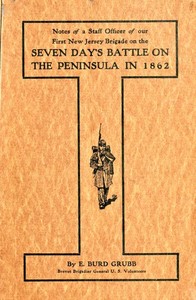
Notes of a staff officer of our First New Jersey Brigade on the Seven Day's Battle on the peninsula in 1862 — Reading Companion
(0 User reviews)
71
Project Gutenberg
2010
Not confirmed
Seven Days' Battles, Va., 1862; United States -- History -- Civil War, 1861-1865 -- Regimental histories -- New Jersey Infantry -- Kearny's Brigade
Readers of public-domain and historical texts
Project Gutenberg digital edition
en
Edition facts
Words
16,473
Reading time
72 min
Text sections
2
For Notes of a staff officer of our First New Jersey Brigade on the Seven Day's Battle on the peninsula in 1862 — Reading Companion, the stored edition analysis reports 16,473 words, 1 hr 12 min estimated reading time, and 2 detected text sections.
The text analysis averages about 28.1 words per sentence, while the detected sections provide another way to judge how the source is divided.
Project Gutenberg metadata also associates the work with “Seven Days' Battles, Va., 1862,” connecting these edition facts with the source record’s subject description.
Source:
Project Gutenberg record #34216
A staff lieutenant's firsthand account of the Seven Days' Battles, focusing on the First New Jersey Brigade's movements, exhaustion, and retreat. The narrative voice shifts from precise military detail to personal vignettes, revealing the strain of command and the human cost of the campaign.
Read the complete public-domain text at its original source.
Read on Project GutenbergE. Burd Grubb's account of the Seven Days' Battles is written in a voice that oscillates between the formal precision of a staff officer and the weary intimacy of a young lieutenant. The narrative opens with a meticulous description of brigade movements around Mechanicsville, noting specific roads, bridges, and the position of General Taylor. Yet within the same paragraph, Grubb pauses to mention that Captain Royal, wounded in a cavalry attack, was known in Burlington, New Jersey, for having married a sister of Admiral John Howell. This blend of tactical detail and local connection sets the tone for a memoir that is as much about the men and their ties as about the battle itself.
A Voice of Exhaustion and Duty
Grubb's prose often mirrors the physical and mental fatigue of the campaign. In one passage, he describes finding General Taylor utterly exhausted in a fence corner, having had no nourishment except a cup of coffee since the night before. When Grubb reports that the brigade is mixed up, the general's reply is curt: 'Very well, sir, go straighten it out.' Grubb admits the task was 'too much of a contract for a young man of my age,' and he delegates to Colonel Torbert, who calls him 'sonny.' This moment reveals the informal hierarchy and the strain on command. The language is direct, almost terse, with short sentences that convey urgency and depletion. The men are 'lying down, some of them asleep, all of them cross,' and the effort to reorganize them takes until eleven o'clock. Grubb's voice here is not that of a hero but of a junior officer doing his best under impossible conditions.
The Rhythm of Retreat and Small Mercies
The narrative pace shifts markedly during the retreat toward the James River. Grubb notes that the men realized they were retreating only after the battle of Charles City Crossroads, a fact that was 'heartbreaking' because their faces had been 'towards the Rebel Capitol' since landing at West Point. The march continues through the night, with only a few hours' rest. In a striking personal vignette, Grubb obtains three hardtack from a private named Richard Poole, a painter from Burlington, who gives him half of all he had. Grubb presses a silver ten-cent piece on him as a souvenir, and Poole shows it to him many times afterward. This small exchange, rendered in plain language, contrasts with the larger movements of brigades and the sound of artillery 'going through the tree tops.' The rhythm of the prose slows here, dwelling on a moment of shared privation and friendship, before resuming the relentless march toward Malvern Hill.
Uncertain Geography and the Weight of the Unknown
Grubb frequently emphasizes what the brigade did not know. They marched 'somewhere, we did not know where,' and Malvern Hill was not known by that name or any other name—only as 'a high and commanding position' with batteries already in place. This uncertainty is a recurring structural element: the narrative is built around movements ordered without explanation, roads taken without knowledge of destination. The effect is to place the reader in the same fog of war that the soldiers experienced. Grubb's language is careful to distinguish between what he observed and what he inferred. He does not claim to know the larger strategy; he reports only what he saw from his position on the staff. This restraint gives the account a documentary quality, while the gaps in knowledge underscore the confusion and anxiety of the campaign.
Grubb's narrative is best read as a record of perception under pressure. Pay attention to what he chooses to include—the name of a wounded captain's sister, the taste of coffee given by provost guards, the feel of a blanket in a fence corner—and what he omits, such as any overview of the battle's outcome. The account is valuable not for its strategic insight but for its fidelity to the sensory and emotional experience of a junior officer in a retreating army.
The rain kept time with the pages of that staff officer’s diary, his weariness seeping through the ink until I felt it in my own bones. That same quiet endurance, the weight of a cause carried without complaint, lingered when I set it down. It nudged me, almost by accident, toward another voice of stubborn retreat: Great Indian Chief of the West; Or, Life and Adventures of Black Hawk — Inside the Classic. Two men, two surrenders, one long, tired rain.
There are no reviews for this eBook.
There are no comments for this eBook.
Reader reflection
Your personal reading reflection
Build a private reading journal entry for this title.
Your progress
0
/
10
2
How did the book work for you overall?
3
Would you recommend this book to another reader?
4
How much effort did this book require?
5
How much did the book move you?
6
Did the book meet your expectations?
7
How closely did the book connect with your experience?
8
What did you think about the pace?
9
What is the main idea you are taking away?
10