1

Camp Fire Yarns of the Lost Legion — Background and Themes
(0 User reviews)
90
Project Gutenberg
2013
Not confirmed
Zulu War, 1879; Māori (New Zealand people) -- Warfare; New Zealand -- History -- Anecdotes
Readers of public-domain and historical texts
Project Gutenberg digital edition
en
Edition facts
Words
89,714
Reading time
391 min
Text sections
8
Camp Fire Yarns of the Lost Legion — Background and Themes can be approached with a clearer sense of reading commitment from its source measurements: 89,714 words, 6 hr 31 min estimated reading time, and 8 detected text sections.
The text analysis averages about 30.0 words per sentence, while the detected sections provide another way to judge how the source is divided.
Project Gutenberg metadata also associates the work with “Zulu War, 1879,” connecting these edition facts with the source record’s subject description.
Source:
Project Gutenberg record #42228
A collection of anecdotal tales from colonial campaigns in New Zealand and South Africa, structured as campfire yarns. The author, a veteran officer, recounts scouting missions, skirmishes, and survival in bush and veld, with recurring attention to movement, concealment, and the physical details of gear and terrain.
Read the complete public-domain text at its original source.
Read on Project GutenbergThe book opens with a preface that frames the entire work as a fireside performance: the author, laid up and holding a pen instead of a carbine, invites the reader to imagine him spinning yarns under the stars of South Africa. This conceit governs the structure—each chapter is a self-contained anecdote, often beginning with a direct address or a scene-setting detail. The contents list reveals a two-part division: Part I covers New Zealand (the Maori wars, bushrangers, bushcraft), Part II shifts to Natal and the Lost Legion’s debut. The yarns are not chronological but thematic, linked by the narrator’s voice and the recurring imagery of campfires, horses, and the tension between open veld and dense bush.
Movement and Concealment as Narrative Drivers
Across the excerpts, the narrator’s attention is fixed on how men move through hostile terrain. A scouting mission is described in precise stages: a wide detour to avoid ambush, the careful taking of bearings to front and rear, the choice of a creek bed to ascend a ridge. The prose lingers on the physical cost—icy water, flint-like biscuit, the impossibility of lighting a fire. This is not mere backdrop; the act of moving unseen becomes the story’s engine. The narrator notes that a good scout must remember his route because “he has no time to think much when a war party is after him.” The yarns repeatedly return to this logic of evasion and observation, where survival depends on reading the ground and anticipating the enemy’s gaze.
The Material Culture of the Colonial Scout
The narrator inventories his field kit with a collector’s eye: smasher hats, dark blue serge jumpers drawn up and fastened at the waist, shawls worn like kilts, no trousers. One man wears shooting boots and socks; the others go barefoot with sandals. Arms include carbines, revolvers, a tomahawk, and a sheath knife. The blanket roll holds four pounds each of very bad bacon and worse biscuit. This catalogue is not incidental—it grounds the yarns in the specific, improvised equipment of colonial warfare. The narrator contrasts this with what “the man who has never been out of Britain” might think, implying that the value of the story lies partly in its insider knowledge of gear and its limitations.
Voice and the Campfire Frame
The preface establishes a conversational tone: “Let me fancy I sit by the camp fire again, telling yarns as we used to.” This frame persists in the chapters, where the narrator often addresses the reader directly or inserts asides about the difficulty of the terrain. The yarns are not polished narratives but spoken performances, with digressions and evaluative comments (“It may not seem much … but a Colonial will appreciate the job at its true value”). The dedication to T. F. Kynnersley, “whose fondness for a good story is as keen now as it was in the days of yore,” reinforces the idea that these tales are meant for a listener who shares the experience. The voice is that of a veteran speaking to comrades, not a historian addressing a general audience.
Recurring Images: Bush, Veld, and the Edge of Visibility
The excerpts are rich with repeated visual motifs: the dense New Zealand bush with “trees of gigantic size” and undergrowth that “nothing but a pig or an elephant could get through”; the pumice-stone gullies; the manuka scrub. In South Africa, the landscape shifts to open veld, but the same tension between cover and exposure persists. The narrator describes moving “through deep gullies and through manuka scrub, very often having to head off our road to examine the ground.” The enemy, Te Kooti, is described as a “sly old bird” likely to leave an ambush on his spoor. The yarns are built around moments of near-discovery and narrow escape, where the boundary between seen and unseen determines life or death.
These yarns reward a reader who attends to the physical details of movement and equipment rather than expecting a continuous plot. The book’s structure—discrete anecdotes linked by a narrator’s voice—means it can be opened at any chapter. The preface’s framing as a campfire performance is the key to the tone: the stories are meant to be listened to, not studied. For those interested in the material realities of colonial scouting or the narrative conventions of the military anecdote, this collection offers a specific, unpolished record.
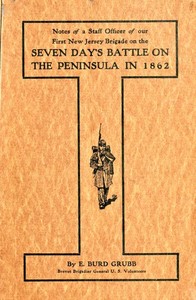
Reading these campfire yarns, I remembered my grandfather’s war stories—always about the weight of a pack, the smell of rain on canvas. Then I recalled Notes of a staff officer of our First New Jersey Brigade on the Seven Day's Battle on the peninsula in 1862 — Reading Companion, and how it, too, held that same quiet patience for small, dusty details of movement and waiting.
There are no reviews for this eBook.
There are no comments for this eBook.
Reader reflection
What was your reading experience?
Capture what you thought, learned, and would like to remember.
Your progress
0
/
10
2
Was reading this book enjoyable?
3
Is this a title you would suggest to others?
4
Did the language feel accessible?
5
Did you relate to its people, ideas, or situations?
6
Did you gain anything practical from the text?
7
How distinctive were its ideas or approach?
8
Which element worked best for you?
9
Which lesson or insight stayed with you?
10