1

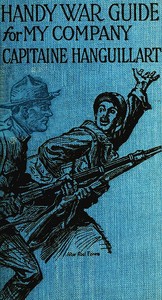
Handy War Guide for My Company: Handy Company Commander's Guide — A Reader’s Guide
(0 User reviews)
79
Project Gutenberg
2013
Not confirmed
United States. Army -- Officers' handbooks; Intrenchments; Siege warfare
Readers of public-domain and historical texts
Project Gutenberg digital edition
en
Edition facts
Words
14,754
Reading time
65 min
Text sections
3
The catalog record for Handy War Guide for My Company: Handy Company Commander's Guide — A Reader’s Guide provides practical reading context through 14,754 words, 1 hr 5 min estimated reading time, and 3 detected text sections.
The text analysis averages about 14.0 words per sentence, while the detected sections provide another way to judge how the source is divided.
Project Gutenberg metadata also associates the work with “United States. Army -- Officers' handbooks,” connecting these edition facts with the source record’s subject description.
Source:
Project Gutenberg record #44370
A 1918 translation of a French captain's front-line manual for company commanders, offering precise tactical advice on trench life, approach formations, and combat principles, with numbered paragraphs and tested orders.
Read the complete public-domain text at its original source.
Read on Project GutenbergCaptain Hanguillart's Handy War Guide for My Company, translated and edited by Louis J. A. Mercier, is a pocket-sized manual written at the front and based on orders the captain used with his own company. The preface notes that its first part was incorporated into official French army manuals, underscoring its practical authority. The text is organized into two main parts: Trench Life and Trench Warfare, and French Infantry Combat Principles, each ending with topical questions. Numbered paragraphs (e.g., 134, 139) present concise, imperative advice, often with explicit intervals and formations.
Formations and Fire Discipline
The manual repeatedly emphasizes precise spacing and movement under fire. Paragraph 134 advises: “Do not stop in a zone under fire for effect as lying down only provides a larger target.” Instead, troops should remain standing and “packed together like sardines.” This counterintuitive instruction reflects experience with high-explosive shells. Protective formations are given with exact yardages: sections in double file, 85 to 110 yards apart, with the second line 250 to 300 yards behind. The text acknowledges that maximum intervals may be shortened “to secure closer order at the expense of greater safety.” Such details reveal a commander balancing casualties with tactical cohesion.
Woods, Crests, and Cavalry Precautions
Specific terrain features receive targeted advice. Small woods are to be avoided because they “draw artillery fire and do not offer sufficient protection”; large woods can hide movements but require careful liaison. Crossing a crest demands assembly below the skyline, then a coordinated leap “across and down the descending slope” to present a moving target. Cavalry threats are addressed with formations: deployment as skirmishers ahead, columns of squads on flanks, and echelons for all-around security. The charge is met by stopping, facing, fixing bayonets, and firing at will under section leaders’ control. These instructions show a systematic approach to varied combat scenarios.
Structure and Omissions as Evidence
The table of contents reveals a methodical scope: from taking over trenches to night attacks and defense of villages. Each part concludes with “Topical Questions,” suggesting the manual was used for instruction and review. The preface claims that “its very omissions are significant” and that “every paragraph is a unit of tried advice.” Yet the excerpts provide no narrative, no personal anecdotes, and no discussion of morale or leadership beyond tactical commands. The catalog subjects list Intrenchments and Siege warfare, but the manual also covers open warfare, approach marches, and anti-cavalry measures—indicating a broader intended use than the subjects alone imply.
Readers should approach this guide as a primary source of early 20th-century infantry tactics, not as a memoir or history. The numbered paragraphs and question sets invite study rather than casual reading. Comparing the table of contents with the actual text reveals what the manual prioritizes—concrete formations and fire discipline—and what it leaves out, such as logistics or medical care. The editor’s note about official adoption adds credibility, but the manual’s value lies in its direct, experience-based prescriptions.
There’s something humbling about reading that 1918 captain’s numbered paragraphs on trench discipline—all that precision meant for men who wouldn’t come home. It makes me think of the other, quieter discipline in The Colored Regulars in the United States Army — Context and Discussion, where the order was simply to endure, and prove, and hold the line. Both books sit heavy on the shelf, like old letters.
There are no reviews for this eBook.
There are no comments for this eBook.
Reader reflection
Record your reading impressions
A brief reflection can help important ideas stay with you longer.
Your progress
0
/
10
2
How much did you enjoy the reading experience?
3
Would you encourage someone else to read it?
4
How much effort did this book require?
5
Did the story or argument move comfortably?
6
Would this book work well in a reading group?
7
How did the reading compare with what you expected?
8
How would you rate its originality?
9
In one sentence, what did you learn?
10