1

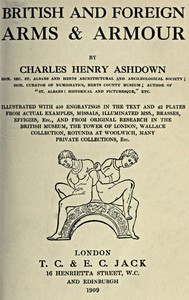
British and Foreign Arms & Armour — Key Ideas to Explore
(0 User reviews)
617
Project Gutenberg
2015
Not confirmed
Armor -- England; Weapons -- Europe; Armor -- Europe; Weapons -- England
Readers of public-domain and historical texts
Project Gutenberg digital edition
en
Edition facts
Words
87,818
Reading time
382 min
Text sections
17
The source record for British and Foreign Arms & Armour — Key Ideas to Explore measures this digital text at 87,818 words, 6 hr 22 min estimated reading time, and 17 detected text sections.
The text analysis averages about 21.9 words per sentence, while the detected sections provide another way to judge how the source is divided.
Project Gutenberg metadata also associates the work with “Armor -- England,” connecting these edition facts with the source record’s subject description.
Source:
Project Gutenberg record #48573
An early 20th-century reference work examining the design and evolution of armor and weapons in England and Europe, structured by historical periods and illustrated with brasses, effigies, and manuscript sources.
Read the complete public-domain text at its original source.
Read on Project GutenbergCharles Henry Ashdown’s British and Foreign Arms & Armour (1909) organizes its material by chronological periods, moving from early medieval mail through the development of plate armor. The book’s structure relies heavily on dated brasses and effigies as primary evidence, with each chapter anchored to specific monuments. Ashdown frequently compares examples from different churches—such as the brasses of Sir John de St. Quintin (1397) and Sir Thomas de St. Quintin in Harpham Church—to trace subtle changes in armor components like the orle, gorget, and coudière.
Brasses as Structural Anchors
Ashdown uses monumental brasses not merely as illustrations but as chronological markers. Each chapter is built around a sequence of dated effigies, allowing him to pinpoint the introduction or disappearance of specific armor features. For instance, the brass of Sir John Lysle (1407) at Thruxton Church is discussed as a candidate for the earliest complete plate armor in England, though Ashdown notes that details like the fan-shaped coudières and the absence of a hauberk suggest the brass may have been executed later. This cautious dating—based on internal evidence from the armor itself—is a recurring method. The brass of Sir John de Leventhorpe (1433) at Sawbridgeworth Church is used to show the transition from the lowermost tace to divided tuilles, with the suspension by two buckles noted as an early English example. By cross-referencing multiple brasses, Ashdown builds a relative chronology that is more precise than relying on documentary records alone.
Recurring Details: The Orle, Gorget, and Coudière
Certain armor elements appear repeatedly across the excerpts, each time with small variations that Ashdown treats as diagnostic. The orle—the padded roll around the bascinet—is described in the brass of Sir Thomas de St. Quintin as “of very large proportions” and ornamented with a brooch in front. The gorget in the same effigy consists of three plates, with “ridged projections over the cheekplates of the bascinet,” a detail Ashdown highlights as peculiar. The coudière (elbow guard) is traced through several examples: on Lord Camoys’ brass in Trotton Church, the fan-shaped defence is visible both inside and out, but the strap fastening is not shown; on Peter Halle’s brass (c. 1420) in Herne Church, the strap crossing the mail is apparent. These observations show Ashdown’s attention to fastening methods and the transition from mail to plate. The roundel and shield-shaped palette used at the arm openings in the St. Quintin brass are noted as “strongly reminiscent of the early camail days,” linking later plate forms to earlier mail traditions.
Movement Between Scenes: Church, Manuscript, and Museum
Ashdown’s evidence moves fluidly between three settings: church brasses and effigies, illuminated manuscripts, and museum collections. The preface lists the British Museum, the Tower of London, the Wallace Collection, and the Rotunda at Woolwich as sources, alongside “many private collections.” In the text, a typical passage might begin with a brass in a specific church (e.g., Sir William Calthorpe, 1420, in Burnham Thorpe Church, Norfolk), then compare it to a manuscript illustration (e.g., Harl. MS. 4379 for shields), and finally reference a museum example. This triangulation allows Ashdown to compensate for the limitations of any single source: brasses may be idealized, manuscripts may be stylized, and museum pieces may lack provenance. The movement is not random but serves to corroborate or qualify observations. For instance, when discussing the laminated defences for the back of the genouillière on the St. Quintin brass, he considers whether they represent early lames or simply banded mail with omitted vertical lines—a question that could be resolved by examining surviving examples in collections.
Shields and the Problem of Individual Variation
Shields in the Surcoatless Period are described as “invariably small in size and notched for the lance,” but Ashdown immediately notes that “every knight apparently designed his own,” making enumeration impossible. This acknowledgment of individual variation is a recurring theme: while the book seeks to establish general typologies, it repeatedly encounters exceptions. The shields illustrated from Harl. MS. 4379 show a variety of shapes and devices, but Ashdown refrains from overgeneralizing. Instead, he uses the shield as an example of how personal choice complicates the study of armor. The concave surface designed to deflect the opponent’s lance is a functional detail that he explains without assuming uniformity. This section of the book thus serves as a reminder that the evidence is fragmentary and that many aspects of medieval armor remain unknowable. Ashdown’s method is to present what can be observed from surviving examples and to flag uncertainties rather than smooth them over.
Readers approaching this work should be prepared for a dense, example-driven text that assumes familiarity with basic armor terminology. The book’s value lies in its systematic comparison of dated monuments, making it a useful reference for identifying armor in other brasses or effigies. Ashdown’s cautious tone—often noting when a feature is “possibly the only example” or “strongly reminiscent” of an earlier period—invites the reader to weigh the evidence alongside him. For those interested in the material culture of medieval warfare, this remains a methodical, if dated, guide to the visual record.
Flicking through the old plates of British and Foreign Arms & Armour, I paused at a brass of a knight in mail, and my mind wandered to another sort of strength—the quiet resilience of a man fighting with far less. It made me think of Great Indian Chief of the West; Or, Life and Adventures of Black Hawk — Inside the Classic, where courage wears no steel at all.
There are no reviews for this eBook.
There are no comments for this eBook.
Reader reflection
Take a moment to reflect on this book
Create a short personal record of your experience with this book.
Your progress
0
/
10
2
How much did you enjoy the reading experience?
3
Would you pass this book on to a friend?
4
What was the reading difficulty like?
5
Did any part of the book stay with you emotionally?
6
Do you expect to return to this book?
7
How did the pace of the book feel?
8
How useful were the ideas in this book?
9
What did this book teach you most?
10