1

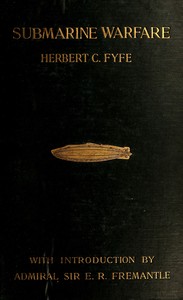
Submarine Warfare, Past, Present, and Future — Text and Context
(0 User reviews)
248
Project Gutenberg
2020
Not confirmed
Submarine warfare
Readers of public-domain and historical texts
Project Gutenberg digital edition
en
Edition facts
Words
91,515
Reading time
398 min
Text sections
19
The source record for Submarine Warfare, Past, Present, and Future — Text and Context measures this digital text at 91,515 words, 6 hr 38 min estimated reading time, and 19 detected text sections.
The text analysis averages about 26.1 words per sentence, while the detected sections provide another way to judge how the source is divided.
Project Gutenberg metadata also associates the work with “Submarine warfare,” connecting these edition facts with the source record’s subject description.
Source:
Project Gutenberg record #62908
Herbert C. Fyfe's 1902 work traces submarine development from early inventors like David Bushnell to contemporary vessels, blending technical description with historical narrative. The preface positions it as a popular account for general readers, while excerpts reveal detailed mechanical descriptions and a focus on practical challenges.
Read the complete public-domain text at its original source.
Read on Project GutenbergHerbert C. Fyfe opens his 1902 work by noting the absence of a popular English-language book on submarine warfare, citing only Lieutenant G. W. Hovgaard's 98-page Danish treatise from fifteen years prior. The preface explicitly aims to fill this gap for readers 'who have neither the time nor the inclination to pursue the subject very deeply,' while still hoping to serve students of naval history. This dual audience shapes the book's approach: technical details appear, but the author promises to 'avoid technicalities as far as possible.' The catalog subjects list only 'Submarine warfare,' yet the excerpts show a work equally concerned with historical narrative, engineering description, and the human stories of inventors.
A Popular History with Technical Roots
The preface reveals Fyfe's deliberate strategy: he began compiling the work two years prior, aiming for a 'popular character.' Yet the book includes 'a certain amount of detailed description,' as seen in the chapter on David Bushnell. There, Fyfe reproduces Bushnell's 1789 letter to Thomas Jefferson in full, describing the submarine's 'two upper tortoise shells of equal size' and its brass crown with 'three round doors.' The letter's inclusion—nearly verbatim—shows Fyfe relying on primary sources to ground his narrative. The result is a text that shifts between accessible summary and dense technical quotation, reflecting the tension between popular appeal and documentary thoroughness.
Inventor Portraits and Practical Mechanics
The Bushnell section exemplifies Fyfe's method: he introduces the inventor as 'the originator of the modern method of submarine warfare,' then lets the inventor's own words describe the vessel. Details like the 'water-gauge or barometer' for depth, 'two brass forcing pumps' for ascent, and 'air-pipes' that 'shut themselves whenever the water rose near their tops' convey practical mechanics without overwhelming the reader. Fyfe also includes a note on a later accident: a submarine sank in '22 fathoms' and the pressure 'crushed in the sides of the chamber.' These concrete details ground the historical account in real-world consequences, avoiding abstract theory.
Structure and Intended Audience
The book's structure—historical survey, technical explanation, and future speculation—is outlined in the preface: Fyfe traces 'under-water warfare from the earliest times to the present day,' explains 'how a submarine boat is worked,' and attempts 'to arrive at some conclusions respecting a mode of fighting which may possibly figure largely in future battles.' The inclusion of a chapter by Sir Edward J. Reed on 'The Probable Future of Submarine Boat Construction' extends this forward-looking aim. Despite the catalog's 'Adventure & Picaresque Fiction' category, the excerpts show no fictional elements; the work is firmly non-fiction, aimed at a general public with growing interest in naval matters, as Fyfe notes: 'Interest in the navy and in naval matters is fortunately greater than it used to be.'
Readers should approach this book as a document of its time—1902, before the World Wars transformed submarine warfare. Fyfe's reliance on primary sources like Bushnell's letter and his careful balance of technical detail with accessible prose make the work valuable for those interested in early submarine development. The excerpts suggest a methodical, evidence-based narrative that avoids sensationalism, focusing instead on the practical challenges and incremental innovations of inventors. For the modern reader, the book offers a window into how submarine technology was understood and presented to the public at the turn of the century.
It’s funny how a book about old machines can stay with you, not for the mechanics, but for the quiet human worry beneath them—the fear and hope pressed into every design. I kept thinking about that when I finished The Interest of America in Sea Power, Present and Future — Reading Notes. Same era, same salt air, but it felt more like a long, thoughtful pause than a history lesson. It lingered gently.
There are no reviews for this eBook.
There are no comments for this eBook.
Reader reflection
How did this book work for you?
Your answers remain private and are stored only in this browser.
Your progress
0
/
10
2
What was your overall reaction to the book?
3
Would you encourage someone else to read it?
4
How easy was the book to follow?
5
What was its emotional impact?
6
Could you see yourself revisiting this book?
7
How would you describe its reading pace?
8
Did it raise ideas you would like to talk about?
9
In one sentence, what did you learn?
10