1

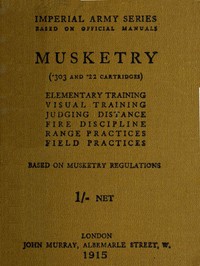
Musketry (.303 and .22 cartridges) Elementary training, visual training, judging distance, fire discipline, range practices, field practices — Reading Notes
(0 User reviews)
846
Project Gutenberg
2018
Not confirmed
Shooting, Military; Rifles; Grenades
Readers of public-domain and historical texts
Project Gutenberg digital edition
en
Edition facts
Words
81,423
Reading time
355 min
Text sections
12
Before opening Musketry (.303 and .22 cartridges) Elementary training, visual training, judging distance, fire discipline, range practices, field practices — Reading Notes, the edition data offers a quick orientation: 81,423 words, 5 hr 55 min estimated reading time, and 12 detected text sections.
The text analysis averages about 17.8 words per sentence, while the detected sections provide another way to judge how the source is divided.
Project Gutenberg metadata also associates the work with “Shooting, Military,” connecting these edition facts with the source record’s subject description.
Source:
Project Gutenberg record #56395
A 1915 manual for British infantry musketry training, combining technical instruction on .303 and .22 rifles with commercial advertisements for military equipment. The text reveals a tension between standardized drill and the improvisation demanded by trench warfare, using precise clock-face and finger-breadth methods for target indication.
Read the complete public-domain text at its original source.
Read on Project GutenbergThis 1915 manual, part of the Imperial Army Series, presents a striking juxtaposition: its opening pages are filled with advertisements for waterproof coats, air rifles, and the Youlten Hyposcope Rifle Sight, priced at £7-10-0. The commercial content, including testimonials from officers at the front, frames the subsequent technical instruction as both a product and a necessity of wartime. The manual's core—detailed lessons on target indication, judging distance, and fire discipline—is delivered in a terse, procedural tone that assumes a reader already familiar with the basics of soldiering.
The Clock-Face and Finger-Breadth: A Language for Fire Control
The manual devotes considerable space to two methods of target indication: the clock-face and the finger-breadth. In the clock-face method, a description-point (such as a poplar or house) becomes the center of an imaginary vertical clock. Targets are then located by hour and direction—for example, “bend—right—two o’clock.” The finger-breadth method uses the width of a finger held at arm’s length to measure angular offsets, as in “one finger below house.” These techniques are not merely theoretical; they are illustrated with landscape diagrams and sample commands like “At 800—at foot of big tree two fingers left of poplar.—Five rounds. Fire.” The system is designed to work even in featureless terrain, where similar description-points (e.g., “hedge right” and “hedge left”) are permitted despite the general rule against it. This precision reflects a military need for unambiguous communication under fire, where a misheard order could be fatal.
Advertisements as Historical Artifacts: The Business of War
The manual’s front matter is a catalog of military suppliers: Graham & Latham’s rifle sights, Simpson & London’s overcoats, and the Birmingham Small Arms Company’s air rifles. One advertisement for the B.S.A. Air Rifle claims it is “just as accurate as any Miniature Rifle, and very much cheaper,” offering a home practice outfit for 50 shillings. Another promotes “Safetipaste,” a bore preserver that “will kill all fouling and preserve the bore for any length of time.” These ads, placed by companies with royal warrants, reveal a wartime economy where private firms supplied both the British Army and individual soldiers. The testimonials—such as a major’s note that “The British Warm Coat you made me is the best I have ever had”—blur the line between product endorsement and military report. For the modern reader, these pages offer a glimpse into the material culture of World War I, where even training manuals were vehicles for commerce.
Drill, Discipline, and the Limits of Standardization
The manual’s instructional sections emphasize repetition and uniformity. Fire discipline is taught through scripted commands: “At 1,000—at centre of hedge running from left of poplar.—Ten rounds. Rapid fire.” The language is impersonal, with no mention of individual soldiers’ judgment. Yet the excerpts also hint at the chaos of actual combat. The section on “Description of Targets” acknowledges that fields of fire may have “very little detail,” forcing commanders to combine methods. The manual’s existence—published in 1915, after the war’s first year—suggests a need to standardize training for mass armies. But the very complexity of its target-indication system, with its nested combinations of description-points, finger-breadths, and clock-face positions, implies that battlefield reality resisted such codification. The manual is thus a document of aspiration: an attempt to impose order on the disorder of trench warfare through meticulous procedure.
Readers approaching this manual should attend to its dual nature: as a technical handbook and as a period artifact. The advertisements and the instructional text together form a composite picture of military life in 1915, where the business of war and the business of training were inseparable. The manual’s value lies not only in its methods but in what it assumes about its audience—soldiers who needed to learn, quickly, a shared language of fire control.
Fingering that old musketry manual, I remembered my granddad’s stories of range days, the smell of Hoppe’s No. 9, the quiet before the bolt clacked home. It wasn’t the drill itself, but the pause to judge distance, a breath held. That same unhurried weight came back with Handy War Guide for My Company: Handy Company Commander's Guide — A Reader’s Guide, another book that felt less like instruction and more like a steady hand on a shoulder.
There are no reviews for this eBook.
There are no comments for this eBook.
Reader reflection
What did you think of this book?
Answer a few questions and save a private reflection on this device.
Your progress
0
/
10
2
How much did you enjoy the reading experience?
3
Would you encourage someone else to read it?
4
What was the reading difficulty like?
5
Could you apply anything you learned?
6
Was the book easy to understand?
7
Would a second reading be valuable?
8
Did the book deliver what you hoped for?
9
What is the main idea you are taking away?
10