1

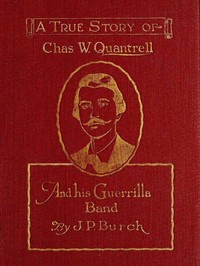
Charles W. Quantrell — Inside the Classic
(0 User reviews)
847
Project Gutenberg
2020
Not confirmed
Guerrilla warfare; Missouri -- History -- Civil War, 1861-1865; Kansas -- History -- Civil War, 1861-1865; Quantrill, William Clarke, 1837-1865
Readers of public-domain and historical texts
Project Gutenberg digital edition
en
Edition facts
Words
56,493
Reading time
246 min
Text sections
42
The catalog record for Charles W. Quantrell — Inside the Classic provides practical reading context through 56,493 words, 4 hr 6 min estimated reading time, and 42 detected text sections.
The text analysis averages about 20.0 words per sentence, while the detected sections provide another way to judge how the source is divided.
Project Gutenberg metadata also associates the work with “Guerrilla warfare,” connecting these edition facts with the source record’s subject description.
Source:
Project Gutenberg record #61100
A firsthand account of Quantrell's guerrilla warfare on the Missouri-Kansas border, structured as a series of episodic battles and raids, with recurring imagery of burning houses and night marches.
Read the complete public-domain text at its original source.
Read on Project GutenbergThis narrative, told by Captain Harrison Trow to John P. Burch, proceeds as a sequence of discrete engagements—each chapter titled after a fight, a farm, or a town—rather than a continuous biography. The structure mirrors the hit-and-run logic of guerrilla warfare itself: brief, violent episodes separated by intervals of movement and concealment. Recurring images of burning houses and devastated neighborhoods appear throughout, establishing a landscape defined by arson and displacement. The text often shifts between tactical specifics—the number of men, the layout of streets—and atmospheric description, as in the Lawrence raid chapter, where a balmy August night precedes the massacre. This alternation between precise detail and ominous mood gives the work a distinctive rhythm.
Episodic Structure and the Chapter as Skirmish
The table of contents reads like a campaign map: thirty-eight chapter headings name specific fights, farms, and towns—Fight at Charles Younger’s Farm, Blue Springs Fight, The Grinter Fight. Each chapter typically covers a single action, with little connective tissue between them. This structure mirrors the fragmentary nature of guerrilla warfare, where engagements are sudden and isolated. The narrative does not build toward a single climax but accumulates incidents, each self-contained. The reader moves from one skirmish to the next, much as the guerrillas moved from one target to another. The effect is a mosaic of violence rather than a linear story.
Recurring Images of Fire and Devastation
Throughout the excerpts, fire appears as both tactic and consequence. Houses are burned “by the hundred,” whole neighborhoods “laid waste.” In the Lawrence chapter, Quantrell threatens to “paint the city blacker than hades.” The imagery is not merely descriptive but structural: each burning marks a point of no return, a transformation of the landscape. The text returns to these scenes repeatedly, suggesting that arson is as central to the guerrillas’ method as ambush. The repetition of such images creates a cumulative sense of ruin, even when the narrative moves quickly from one fight to the next.
Movement Between Scenes: The March and the Rendezvous
The narrative often pauses on the threshold of action—the gathering at Captain Purdee’s house, the roll call of 310 men, the night march to Lawrence. These scenes of assembly and movement are rendered with care: the sultry summer day, the whispered farewells of birds, the massing of men in shadows. The text lingers on the transition between stillness and violence, using natural detail to heighten tension. This attention to the approach rather than merely the attack gives the work a distinctive pacing. The reader is made to feel the weight of the ride, the secrecy, the foreboding, before the fighting begins.
Voice and Testimony: Trow’s Firsthand Account
The work is framed as a dictated memoir: Burch writes that the narrative was “written just as he told it to me.” This oral quality surfaces in the directness of the prose and the inclusion of quoted dialogue among the guerrillas. When Quantrell asks for opinions before Lawrence, the responses are terse and visceral—“Lawrence or hell,” says Anderson. The text does not distance itself from the speakers; it reproduces their voices without moral commentary. This documentary stance, combined with the episodic structure, gives the book the feel of a debriefing rather than a history. The reader is placed in the position of a listener, receiving testimony that is raw and unshaped.
Readers should approach this work as a participant’s account, not a comprehensive history. The episodic structure and recurring imagery of fire reward attention to pattern rather than plot. Because the narrative is built from discrete fights, it can be read in sections without losing context. The text’s value lies less in its factual completeness than in the voice it preserves—a guerrilla’s own telling of the border war, with all its gaps and emphases intact.
Reading again about Quantrell’s night marches, those silent columns under a burning sky, I found myself thinking of a different kind of patience—the careful trigonometry of buried charges in another war. There’s a strange kinship between a raid’s sudden violence and the slow, calculated waiting underground. Both ask you to hold your breath. That other manual, Use of Mines in Trench Warfare (From the French School of St. Cyr) — Context and Discussion, felt like a quiet echo of that same grim arithmetic.
There are no reviews for this eBook.
There are no comments for this eBook.
Reader reflection
How will you remember this book?
Save your reaction, strongest insight, and memorable passage.
Your progress
0
/
10
2
What was your overall reaction to the book?
3
Would you pass this book on to a friend?
4
How easy was the book to follow?
5
Would you like to discuss this book with someone?
6
How clearly were the main ideas presented?
7
Did anything about the book feel genuinely new?
8
Did the story or argument move comfortably?
9
What changed or sharpened your thinking?
10