1

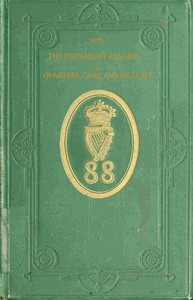
With the Connaught Rangers — Themes and Context
(0 User reviews)
417
Project Gutenberg
2024
Not confirmed
Soldiers -- Great Britain -- Biography; Great Britain. Army. Regiment of Foot, 88th (Connaught Rangers)
Readers of public-domain and historical texts
Project Gutenberg digital edition
en
Edition facts
Words
69,706
Reading time
304 min
Text sections
22
With the Connaught Rangers — Themes and Context can be approached with a clearer sense of reading commitment from its source measurements: 69,706 words, 5 hr 4 min estimated reading time, and 22 detected text sections.
The text analysis averages about 20.5 words per sentence, while the detected sections provide another way to judge how the source is divided.
Project Gutenberg metadata also associates the work with “Soldiers -- Great Britain -- Biography,” connecting these edition facts with the source record’s subject description.
Source:
Project Gutenberg record #73767
General E.H. Maxwell's memoir of service with the 88th Connaught Rangers, moving from Ireland to Malta, the West Indies, the Crimea, and India. The narrative shifts between regimental anecdotes, travel observations, and a dramatic account of a Kashmir flood, revealing a voice that balances professional duty with personal adventure.
Read the complete public-domain text at its original source.
Read on Project GutenbergGeneral E.H. Maxwell's memoir of the Connaught Rangers opens not with a parade-ground review but with a chapter titled 'My first Experiences in the Regiment' that immediately establishes a tone of wry, self-deprecating anecdote. The author's voice is that of a seasoned officer who recounts 'half-a-crown's worth of Fighting' at Donnybrook Fair and a 'Cruel Joke' aboard a transport with the same matter-of-factness he later applies to a flood in Kashmir. The narrative moves briskly from Ireland to Malta, the West Indies, and the Crimea, but the pace is not uniform: regimental routines and comic episodes give way to more sustained, tense passages, particularly during a sudden river rise in the Punjaub section. Maxwell's prose shifts accordingly, from clipped reportage to a more descriptive, almost novelistic style when describing the rising waters and the 'fearful sound—once heard, never to be forgotten—a house crumbling to the ground.'
Anecdotal Rhythm and Regimental Voice
The early chapters rely on a rapid succession of short, self-contained stories. Maxwell moves from 'Toby White' to 'The Castle Guard' to 'Donnybrook Fair' within a few paragraphs, each episode introduced with a chapter-heading style that promises variety. This rhythm mimics the oral tradition of mess-table storytelling: a joke, a near-disaster, a character sketch. The voice is that of a man who has seen much and is not afraid to laugh at himself or his comrades. For instance, the 'Cruel Joke' aboard a transport is told without moralising, and the 'old Colonel’s opinion of Rome and its Ruins' is given as a punchline. This brisk, anecdotal pace dominates the first half of the excerpts, creating a sense of a career composed of discrete, memorable incidents rather than a continuous narrative.
Shift in Pace: From Barrack-Room to Rising Water
A marked change occurs in the Punjaub section, where the narrative slows to a more sustained, descriptive mode. The flood at Nishat Bagh is recounted with accumulating detail: 'the river had already risen twenty feet,' 'the green bank on which our tents had been pitched was gradually becoming covered with water.' Maxwell abandons the quick-cut anecdote for a chronological, almost hourly account of the rising waters, the collapse of a bungalow 'like a building of cards,' and the family's retreat to a boat. The prose becomes more sensory—'the stillness of the hour was only broken by the howling of homeless dogs'—and the pacing mirrors the slow, anxious waiting. This shift suggests that Maxwell's narrative voice is flexible, capable of moving from the clipped efficiency of a regimental report to the immersive detail of a travel memoir when the situation demands.
Recurring Details: Animals, Boats, and the Unforeseen
Throughout the excerpts, certain details recur, linking disparate episodes. Boats appear repeatedly: the 'dongahs' on the Jhelum, the 'big boat' made comfortable by his wife, the 'craft in which we had travelled from Barramula.' Animals also feature prominently—a bear smuggled aboard ship, a chicken named Nourmahal rescued from the flood, a rat and a serpent swimming together. These details are not merely decorative; they often serve as pivots for the narrative. The chicken 'fraternised with us' and becomes a companion, while the rat and serpent are observed with detached wonder. Maxwell's eye for the incongruous—a Pariah dog on a floating door, a cherry tree used as a mooring—gives his writing a particular texture, grounding grand events in small, vivid observations. These recurring motifs suggest a mind that registers the unexpected with a mixture of practicality and curiosity.
Maxwell's memoir rewards a reader attentive to shifts in tempo and register. The early chapters, with their rapid-fire anecdotes, can be sampled for their comic and characterful glimpses of Victorian military life. The later, more sustained passages—particularly the flood narrative—invite closer reading for their descriptive power and emotional restraint. The author's voice is that of a professional soldier who is also a keen observer of the natural world and human behaviour. Readers may find it useful to note how Maxwell's prose lengthens and intensifies when he is describing a scene of genuine peril, and how quickly it returns to a lighter, more anecdotal tone once the crisis passes.
When General Maxwell writes of the Crimea, I sometimes think of that pamphlet arguing about Bunker Hill—both men wrestling with the same human muddle, the fog of glory and misremembered orders. His regimental flood, her smoky hill, each a quiet accounting of what war truly demands. The kinship is in their patient, unshowy honesty. Who was the Commander at Bunker Hill? With Remarks on Frothingham's History of the Battle — Reading Notes sits beside it well.
There are no reviews for this eBook.
There are no comments for this eBook.
Reader reflection
How did this book work for you?
Your answers remain private and are stored only in this browser.
Your progress
0
/
10
2
How much did you enjoy the reading experience?
3
Is this a title you would suggest to others?
4
How much effort did this book require?
5
Which part made the strongest impression?
6
How understandable was the text?
7
Was the book moving at the right speed?
8
Is this a title worth rereading?
9
In one sentence, what did you learn?
10