1

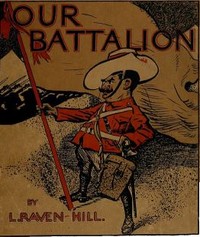
Our Battalion Being Some Slight Impressions of His Majesty's Auxiliary Forces, in Camp and Elsewhere — A Closer Reading
(0 User reviews)
1511
Project Gutenberg
2010
Not confirmed
Caricatures and cartoons -- Great Britain; Armies -- Caricatures and cartoons
Readers of public-domain and historical texts
Project Gutenberg digital edition
en
Edition facts
Words
17,510
Reading time
77 min
Text sections
3
The catalog record for Our Battalion Being Some Slight Impressions of His Majesty's Auxiliary Forces, in Camp and Elsewhere — A Closer Reading provides practical reading context through 17,510 words, 1 hr 17 min estimated reading time, and 3 detected text sections.
The text analysis averages about 16.7 words per sentence, while the detected sections provide another way to judge how the source is divided.
Project Gutenberg metadata also associates the work with “Caricatures and cartoons -- Great Britain,” connecting these edition facts with the source record’s subject description.
Source:
Project Gutenberg record #34115
Leonard Raven-Hill's 1902 collection of cartoons and humorous sketches satirizes the British volunteer army through caricatures, mock diaries, and deadpan observations of camp life, training mishaps, and the gap between official pomp and everyday absurdity.
Read the complete public-domain text at its original source.
Read on Project GutenbergLeonard Raven-Hill's Our Battalion opens not with a parade-ground fanfare but with a boy hesitating in a wet street, muttering “I've 'arf a mind not to go.” That reluctant recruit sets the tone for a book that treats military service as a series of comic inconveniences rather than heroic exploits. Published in 1902 by Punch office, the volume collects cartoons and prose sketches originally aimed at readers familiar with the auxiliary forces—volunteers who drilled part-time and were often the butt of jokes about inefficiency.
The excerpts reveal a work built on two recurring devices: the mock diary (four separate diarists, from a colonel to a private) and the single-panel cartoon with a caption that punctures official rhetoric. Raven-Hill’s eye for the gap between regulation and reality—a jammed bayonet, a wasp’s nest under the lunch spot, a subaltern who sights his rifle at four different ranges—gives the book its consistent comic energy.
Recruits and Reluctance
The opening sketch, “Recruits,” establishes a pattern of hesitation and peer pressure. The boy who “’ad ’arf a mind not to go” is nudged along by a friend already in uniform, who asks “Wot are you scared about?” The dialogue is clipped, colloquial, and full of dropped h’s—Raven-Hill renders speech phonetically to mark class and region. The orderly room is described as “a little box partitioned off from the disused malt-house,” a setting that signals the makeshift nature of volunteer soldiering.
This attention to physical detail recurs throughout. The “First Puttie Parade” cartoon (listed in the contents) hints at the comedy of wrapping leggings; the “Manual” cartoon suggests drill-book absurdity. Raven-Hill does not need to explain the joke—the juxtaposition of official language and shabby reality is enough. Readers should watch for how the illustrations (not reproduced here) likely amplify the text’s deadpan humor.
Four Diarists, Four Voices
The book’s structural centerpiece is a set of four “Camp Diaries” by Lt.-Col. Sir Digby Sandilands, M.P.; Capt. and Adjt. “Jerry” Benson; 2nd Lieutenant Fitzgerald Lawless; and Pte. Timothy Simmons. Each voice is distinct. The colonel’s diary (not excerpted) presumably frets over inspections; the adjutant’s entry for Friday records a “positively dreadful time” when the G.O.C. would not leave the firing line, and a staff officer quips that Volunteers combine “the minimum of expense with the maximum of inefficiency.”
Lawless’s diary, by contrast, is breezy and self-regarding. He complains about baggage limits, boasts of “huge jest” with a fellow subaltern, and notes that his tent is “pitched close to the Colonel’s; rather a good egg, as they won’t be able to try any larks on this time.” The contrast between Benson’s weary professionalism and Lawless’s blithe confidence creates a layered portrait of camp life. Private Simmons’s diary (not excerpted) likely offers a third perspective from the ranks.
Cartoons That Do the Punching
Raven-Hill was a Punch cartoonist, and Our Battalion is as much a visual as a verbal work. The contents page lists twenty-two cartoons with titles like “Not to be Trifled with,” “Flag-wagging,” and “The Firing Exercise.” The frontispiece shows a sentry at 3 a.m. grumbling, “Sunrises are all bloomin’ fine in their way, but I’d rather be in bed.” The caption undercuts any romantic notion of dawn duty.
Other cartoon titles hint at running gags: “Our First Puttie Parade” (puttees were cloth leggings notoriously tricky to wrap), “Field-Day Reflections” (a field officer lost in khaki, unable to spot his own men), and “Tactics” (a subaltern claiming to have sighted at four different ranges). The humor relies on insider knowledge of military jargon and routine, but the universal theme—official systems collapsing under human frailty—makes it accessible. Readers should imagine the cartoons as the book’s primary punchline, with the prose providing context.
The Joke of Inefficiency
A persistent thread in the excerpts is the gap between what military regulations demand and what volunteers actually do. The adjutant’s diary records that men “insisted on standing up to see the Commander-in-Chief and Staff go by, when they were supposed to be under cover and lying down.” The staff officer’s quip about “minimum of expense with the maximum of inefficiency” is the book’s thesis in a nutshell.
This theme appears in smaller moments too: the “hired charger” (a horse) that is “not a Thing of Beauty,” the subaltern who asks if the war game “Kriegspiel” can make money, the private who loses his company and jokes “Not lost, but gone before!” Raven-Hill treats the volunteers’ shortcomings as endearing rather than damning. The book’s title—Our Battalion—claims a affectionate ownership. Readers should note that the humor is never cruel; it laughs with the recruits, not at them.
Our Battalion rewards a reader who can appreciate period detail—the puttees, the Sam Browne equipment, the “ord’ly room” in a malt-house—without needing every reference explained. The four diaries work best when read in sequence, as each voice comments on the same events from a different rank. The cartoons, though absent from this e-text, are essential to the book’s effect; their captions often deliver the punchline that the prose sets up. Approach the book as a time capsule of Edwardian volunteer culture, where the joke is always on the system, not the soldier.
The rain made a soft drum on the window while I laughed at Raven-Hill’s volunteers, their polished buttons undone, their dignity forever askew. After closing that worn volume, I found myself wondering about the uniforms themselves, the quiet grammar of rank, and my hand drifted of its own accord toward Army and Navy Uniforms and Insignia How to Know Rank, Corps and Service in the Military and Naval Forces of the United States and Foreign Countries — A Closer Reading. The afternoon simply folded into that other mystery.
There are no reviews for this eBook.
There are no comments for this eBook.
Reader reflection
How did this book work for you?
Your answers remain private and are stored only in this browser.
Your progress
0
/
10
2
What was your overall reaction to the book?
3
Would you encourage someone else to read it?
4
How much effort did this book require?
5
Was the book easy to understand?
6
Which element worked best for you?
7
Would you like to discuss this book with someone?
8
Did this book create an emotional response?
9
In one sentence, what did you learn?
10