1

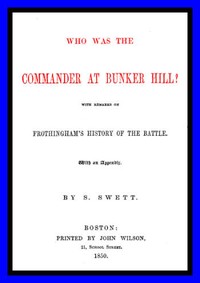
Who was the Commander at Bunker Hill? With Remarks on Frothingham's History of the Battle — Reading Notes
(0 User reviews)
71
Project Gutenberg
2014
Not confirmed
Bunker Hill, Battle of, Boston, Mass., 1775; Frothingham, Richard, 1812-1880. History of the siege of Boston, and of the battles of Lexington, Concord, and Bunker Hill
Readers of public-domain and historical texts
Project Gutenberg digital edition
en
Edition facts
Words
16,101
Reading time
71 min
Text sections
2
Who was the Commander at Bunker Hill? With Remarks on Frothingham's History of the Battle — Reading Notes can be approached with a clearer sense of reading commitment from its source measurements: 16,101 words, 1 hr 11 min estimated reading time, and 2 detected text sections.
The text analysis averages about 22.8 words per sentence, while the detected sections provide another way to judge how the source is divided.
Project Gutenberg metadata also associates the work with “Bunker Hill, Battle of, Boston, Mass., 1775,” connecting these edition facts with the source record’s subject description.
Source:
Project Gutenberg record #47231
Samuel Swett's 1850 pamphlet challenges Richard Frothingham's account of Bunker Hill, arguing that General Putnam, not a 'headless mob,' commanded the battle. Swett examines command structure, troop organization, and eyewitness testimony to defend Putnam's role against what he sees as a mischaracterization of the New England army.
Read the complete public-domain text at its original source.
Read on Project GutenbergSamuel Swett opens his 1850 pamphlet with a reluctant return to public debate. Thirty-two years after writing his own account of the Battle of Bunker Hill, he finds himself compelled to defend it against Richard Frothingham's recent history. Swett's tone is courteous but pointed: he acknowledges Frothingham's 'intentional honor and honesty' while zeroing in on what he calls a 'sublime' mistake—the claim that the American forces at Bunker Hill fought as a 'headless mob.' This phrase, and Frothingham's characterization of the army as 'an army of allies,' become the focal points of Swett's rebuttal. He argues that such language misrepresents the organization of the New England army, which official records of the Provincial Congress and Committee of Safety consistently term the 'New England army' or 'American army.'
The Structure of the Dispute
Swett structures his argument as a forensic examination of Frothingham's evidence, moving through a series of witness statements and documentary records. He does not present a continuous narrative of the battle but instead builds a case point by point, citing depositions, diaries, and published accounts. Key witnesses include Governor Brooks, Colonel Trumbull, Judge Grosvenor, President Stiles of Yale, and Reverend Dr. Whitney, who served as chaplain to Putnam's regiment. Swett also draws on Rivington's Gazette, noting that Frothingham used one issue but overlooked another from the same paper that reported Putnam taking possession of Bunker Hill. This methodical accumulation of testimony gives the pamphlet the feel of a legal brief, with Swett acting as both prosecutor and defense attorney for Putnam's reputation.
Recurring Images: The 'Headless Mob' and the 'Army of Allies'
Two phrases recur throughout Swett's text: 'headless mob' and 'army of allies.' He treats them as rhetorical weapons that Frothingham uses to undermine the legitimacy of the American command. Swett counters by emphasizing the army's organization under General Ward, 'assisted by a host of accomplished veteran officers,' and by insisting that the troops were not a mob but a structured force. The image of a 'headless' body is particularly charged: Swett implies that Frothingham's account decapitates the army, removing its commander and leaving it leaderless. In response, Swett repeatedly places Putnam at the center of the action—laying out works, directing troops, and commanding from start to finish. The pamphlet thus becomes a struggle over the very vocabulary used to describe the battle.
Movement Between Scenes: From Cambridge to Breed's Hill
Swett's narrative moves between three key locations: Cambridge headquarters, the night march to Breed's Hill, and the battlefield itself. He traces Putnam's movements with precision: on the night of June 16, Putnam went with half the detachment to Breed's Hill, then returned to Cambridge at dawn for reinforcements, only to be called back by the enemy's cannonade. This back-and-forth pattern underscores Putnam's active role and challenges Frothingham's portrayal of him as a mere 'patriotic volunteer.' Swett also highlights the moment when General Ward agreed to put two thousand men under Putnam's command for the intrenchment, a detail that suggests formal authority. By following Putnam's physical trajectory, Swett constructs a counter-narrative of command that is grounded in movement and presence.
The Weight of Eyewitness Testimony
Swett relies heavily on depositions and letters from those who were present. He quotes Reverend Dr. Whitney's explicit statement that Putnam told him 'soon after the battle' that he commanded from beginning to end, a claim repeated in 1790 and again in 1818. Colonel Putnam's letter confirms his father's assertions, and Swett notes that Frothingham dismisses these as possible misunderstandings. Other witnesses include Dr. Aaron Dexter, who recorded that officers at Ward's quarters the day after the battle said Putnam commanded all troops sent overnight; Colonel Bancroft, who saw Putnam lay out the works; and Josiah Cleveland, a soldier in Putnam's regiment who testified that Putnam directed the breastwork at the rail-fence. Swett presents these voices as a chorus that Frothingham cannot ignore, though he admits the evidence is incomplete and the dispute ultimately unresolvable from the excerpts alone.
Swett's pamphlet is best read as a document of historical controversy rather than a definitive account. He does not resolve the question of who commanded at Bunker Hill but instead exposes the fragility of historical memory, where diaries, depositions, and printed gazettes can be marshaled on both sides. Readers should attend to how Swett uses evidence—what he includes, what he omits, and how he frames his witnesses. The pamphlet is a reminder that even foundational events are subject to dispute, and that the act of writing history is itself a battle over command.
There’s something poignant in how Swett, arguing over who truly commanded at Bunker Hill, reminds me that victory and defeat often hinge on voices history nearly forgot. That quiet ache lingers when I think of the sea battles in Famous Sea Fights, from Salamis to Tsu-Shima — Reading Companion, where similar arguments over leadership ripple through the waves, and I find myself musing on how rarely we hear the sailors' side of things.
There are no reviews for this eBook.
There are no comments for this eBook.
Reader reflection
Before you leave, reflect on the book
Use these questions to collect your thoughts before moving on.
Your progress
0
/
10
2
Did this book hold your interest?
3
How likely are you to recommend this book?
4
What was the reading difficulty like?
5
Did the book meet your expectations?
6
Would you like to discuss this book with someone?
7
How understandable was the text?
8
How personally connected did you feel to the book?
9
What changed or sharpened your thinking?
10