1

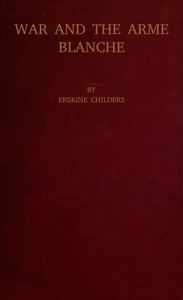
War and the Arme Blanche — A Closer Reading
(0 User reviews)
584
Project Gutenberg
2017
Not confirmed
South African War, 1899-1902; Russo-Japanese War, 1904-1905; Cavalry; Cavalry drill and tactics; Great Britain. Army -- Cavalry -- Drill and tactics
Readers of public-domain and historical texts
Project Gutenberg digital edition
en
Edition facts
Words
129,571
Reading time
564 min
Text sections
25
Before opening War and the Arme Blanche — A Closer Reading, the edition data offers a quick orientation: 129,571 words, 9 hr 24 min estimated reading time, and 25 detected text sections.
The text analysis averages about 24.1 words per sentence, while the detected sections provide another way to judge how the source is divided.
Project Gutenberg metadata also associates the work with “South African War, 1899-1902,” connecting these edition facts with the source record’s subject description.
Source:
Project Gutenberg record #55425
Erskine Childers's 1910 study argues for cavalry reform using evidence from the South African and Russo-Japanese wars. The book contrasts the arme blanche (sword and lance) with firearms, critiques official cavalry training, and examines mounted tactics through specific battles and campaigns.
Read the complete public-domain text at its original source.
Read on Project GutenbergErskine Childers opens War and the Arme Blanche with a direct challenge to the British cavalry establishment, arguing that the lance and sword—the traditional 'arme blanche'—had become obsolete in modern warfare. The book, introduced by Field-Marshal Earl Roberts, systematically examines mounted operations in the South African War (1899–1902) and the Russo-Japanese War (1904–1905) to support its thesis. Childers, who had edited a volume of The Times History of the War in South Africa, draws on detailed tactical analysis rather than abstract theory.
A Controversial Thesis Backed by Battle Evidence
Childers’s central argument is that cavalry should be trained primarily as mounted riflemen, not as shock troops relying on cold steel. He supports this by dissecting specific engagements: the relief of Kimberley, the actions at Elandslaagte, and the guerrilla phase of the war. For instance, he notes that at the relief of Mafeking, Colonel Mahon’s column of 900 mounted irregulars, 100 infantry, and 6 guns marched 251 miles in 14 days—an average of 18 miles a day—with small loss of horseflesh. Childers contrasts this favorably with the cavalry’s performance in the relief of Kimberley, implying that the irregulars’ reliance on firepower and mobility was more effective than the regular cavalry’s emphasis on the arme blanche. He also critiques the 1907 Cavalry Training regulations, which he sees as a step backward from the 1904 edition that had aligned with his views.
The Threefold Problem: Physical, Psychological, and Training
In Chapter II, Childers frames the cavalry question as a 'threefold problem' encompassing physical, psychological, and training dimensions. The physical problem concerns the horse’s endurance and the soldier’s ability to fight mounted or dismounted. The psychological problem addresses the 'cavalry spirit'—the aggressive, shock-oriented mindset that Childers argues often led to reckless charges and poor outpost work. He cites the surrender of 500 Yeomanry near Lindley as an example where 'the true “Cavalry spirit” was lacking in the officer in command,' who allowed his force to be invested. The training problem involves how to balance drill in the arme blanche with marksmanship and fieldcraft. Childers insists that the Boers’ success came from their use of mounted infantry tactics, not from cavalry charges.
Lessons from the Guerrilla War and Russo-Japanese War
Childers devotes significant attention to the guerrilla phase of the South African War, arguing that it revealed the inadequacy of traditional cavalry. He describes how Boer commandos, using mobility and firepower, forced the British to adapt. The book also examines the Russo-Japanese War, where cavalry on both sides rarely used the arme blanche in decisive charges. Childers quotes Bernhardi and other German theorists to show that even continental armies were reconsidering shock tactics. However, he is careful not to overgeneralize: he acknowledges that the South African War was 'a peculiar war' in some respects, but insists that its lessons about firepower and mobility are universal. The final chapter on reform proposes specific changes to cavalry armament, training, and organization, including the creation of mounted infantry units and a revised nomenclature.
Readers should approach War and the Arme Blanche as a polemical work grounded in detailed operational history. Childers’s evidence is drawn from official reports and his own editorial work, but his conclusions remain contentious. The book rewards those interested in military reform, the tactical debates of the early twentieth century, and the interplay between technology and doctrine. It is best read alongside the official histories and training manuals it critiques.
The rain drummed on the window as I finished Childers’s account of lances versus rifles, a strange melancholy settling over me—all that obsolete gallantry. It put me in mind of something quieter, a sort of atlas of lost military worlds. Later, I found myself pulling The Armies of Europe — Story, Setting & Ideas from the shelf, and the afternoon dissolved entirely into its pages.
There are no reviews for this eBook.
There are no comments for this eBook.
Reader reflection
How will you remember this book?
Save your reaction, strongest insight, and memorable passage.
Your progress
0
/
10
2
Was reading this book enjoyable?
3
Would you recommend this book to another reader?
4
How easy was the book to follow?
5
How much did the book move you?
6
How closely did the book connect with your experience?
7
Is this a title worth rereading?
8
Did you gain anything practical from the text?
9
Which lesson or insight stayed with you?
10