1

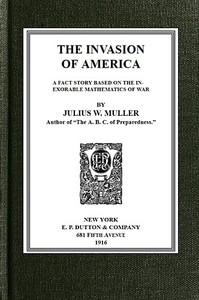
The Invasion of America: a fact story based on the inexorable mathematics of war — Inside the Classic
(0 User reviews)
1135
Project Gutenberg
2016
Not confirmed
Imaginary wars and battles; United States -- Defenses
Readers of public-domain and historical texts
Project Gutenberg digital edition
en
Edition facts
Words
70,396
Reading time
307 min
Text sections
11
For The Invasion of America: a fact story based on the inexorable mathematics of war — Inside the Classic, the stored edition analysis reports 70,396 words, 5 hr 7 min estimated reading time, and 11 detected text sections.
The text analysis averages about 17.2 words per sentence, while the detected sections provide another way to judge how the source is divided.
Project Gutenberg metadata also associates the work with “Imaginary wars and battles,” connecting these edition facts with the source record’s subject description.
Source:
Project Gutenberg record #52038
A 1916 speculative war novel that uses precise geographic and military detail to depict a hypothetical invasion of the United States, focusing on the defense of Boston Harbor and the strategic use of mathematics and technology.
Read the complete public-domain text at its original source.
Read on Project GutenbergJulius W. Muller's The Invasion of America opens with a preface that frames the story as a direct answer to a journalist's question: what could the United States actually do with its existing resources if an enemy landed on the coast? The author insists the work is not meant to scare or promote militarism, but rather to examine preparedness through a lens of factual accuracy. The narrative immediately grounds itself in specific geography and military technology, describing Boston Harbor as a natural fortress with islands and channels that form a 'Pass of Thermopylæ.' The opening chapters establish a tone of clinical analysis, blending technical descriptions of fortifications and naval tactics with a sense of impending conflict.
The Mathematics of War
Muller's subtitle promises a story 'based on the inexorable mathematics of war,' and the excerpts deliver on this claim. The preface notes that all facts were verified against original sources, and the narrative frequently cites ranges, projectile counts, and tactical calculations. For example, the attack on Boston Harbor describes 'five hundred projectiles expended at that one mark alone'—a single searchlight. The invading navy uses 'deep-sea leads and sounding machines' to navigate in darkness, and the defenses are described in terms of 'zones of fire whose intersecting circles marked rings of sure destruction.' This mathematical precision gives the fiction a documentary quality, inviting readers to assess the plausibility of each move.
The Geography of Defense
The book's most striking feature is its detailed use of real locations. Boston Harbor is depicted as a 'glorious harbor great enough for a world’s armada,' protected by two 'great claws' of land: Winthrop peninsula and Nantasket Beach. Islands like Deer Island and George's Island form a 'stone wall with gaps that are the channels.' Muller names specific offshore hazards—the Brewsters, Devil's Back, the Graves, the Roaring Bulls—and describes the kelp-bearded ledges. This cartographic specificity grounds the speculative invasion in a recognizable landscape, making the tactical discussion feel immediate. Readers familiar with the area can trace the action, while others gain a vivid sense of the terrain's strategic importance.
The Invisible Enemy
Muller creates tension by emphasizing what cannot be seen. The invading ships operate in a 'shrouded, black sea where there was not a light to warn of reef or shoal,' groping with sounding machines. The attack begins with 'star-bombs' dropped from aeroplanes, which 'opened, like monster flowers, into glaring, spectrally white flame' that revealed the forts in lightning flashes. The defenders fire blindly at a hidden ocean, while the enemy's 'great war-fowl, the iron breasted aeroplanes' drop lights that 'stood like a lighted staff' to guide naval guns. This interplay of visibility and concealment—the 'deadly blind man’s buff'—drives the early action and underscores the technological asymmetry of modern warfare.
A Story of Preparedness, Not Prophecy
The preface is essential for understanding the book's intent. Muller explicitly states he wrote 'with no idea of suggesting that any Nation or group of Nations may mean to attack us' and rejects the idea that Americans must be 'aroused by terror or hatred' to consider defense. He quotes Lincoln's 'With malice toward none, with charity toward all' as the spirit that should guide preparedness. This framing distinguishes The Invasion of America from jingoistic invasion literature of its era. The story is presented as a thought experiment—a factual, mathematical exercise—rather than a prediction or a call to arms. Readers should approach the narrative as a strategic simulation rooted in 1915 realities, not as a prophecy of future conflict.
Muller's work rewards readers who attend to its technical details and geographic precision. The excerpts suggest a narrative that balances tactical exposition with moments of vivid imagery, such as the 'monster flowers' of star-bombs. Because the complete text is not available here, readers should note that the story's later developments may shift focus from Boston to other theaters. The preface's emphasis on verified facts invites scrutiny of every military claim, making this a book best read with a map of New England at hand.
The rain kept time with the meticulous maps in The Invasion of America, its mathematical certainty oddly soothing. That attention to hulls and harbor defenses made me wonder about the vessels themselves, so I drifted afterwards to Ancient and Modern Ships, Part 1: Wooden Sailing Ships — Reading Companion. Wooden ships felt almost gentle after all that calculating destruction.
There are no reviews for this eBook.
There are no comments for this eBook.
Reader reflection
Your personal reading reflection
Build a private reading journal entry for this title.
Your progress
0
/
10
2
Did this book hold your interest?
3
Is this a title you would suggest to others?
4
How demanding did the text feel?
5
Is this a title worth rereading?
6
How did the reading compare with what you expected?
7
How understandable was the text?
8
Would you start a conversation about this book?
9
What changed or sharpened your thinking?
10