1

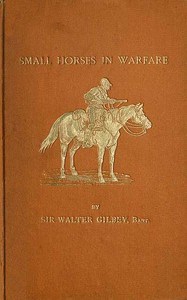
Small Horses in Warfare — A Reader’s Guide
(0 User reviews)
254
Project Gutenberg
2011
Not confirmed
Horses; Ponies
Readers of public-domain and historical texts
Project Gutenberg digital edition
en
Edition facts
Words
14,132
Reading time
62 min
Text sections
2
Small Horses in Warfare — A Reader’s Guide can be approached with a clearer sense of reading commitment from its source measurements: 14,132 words, 1 hr 2 min estimated reading time, and 2 detected text sections.
The text analysis averages about 25.4 words per sentence, while the detected sections provide another way to judge how the source is divided.
Project Gutenberg metadata also associates the work with “Horses,” connecting these edition facts with the source record’s subject description.
Source:
Project Gutenberg record #37842
Sir Walter Gilbey's 1900 treatise argues for breeding small, hardy horses for military use, drawing on evidence from the Crimean War, South Africa, and global pony breeds. The text contrasts the endurance of native ponies with the fragility of larger English horses, advocating a shift in breeding priorities.
Read the complete public-domain text at its original source.
Read on Project GutenbergSir Walter Gilbey opens his 1900 treatise with a pointed lesson from the South African war: the Boers' rapid movements on small horses exposed a British weakness. He argues that the military's reliance on foreign sources for such horses could be remedied by breeding from English foundation stock. The book is not a general history but a targeted polemic, marshalling evidence from Crimea to the American plains to prove that small horses—hardy, low-feeding, and enduring—are peculiarly suited to light cavalry and mounted infantry work.
A Global Survey of Pony Endurance
Gilbey assembles testimony from across continents. He quotes Colonel Dodge on the Indian pony of the American West, which carried an express rider 90–100 miles on three consecutive nights each week for six months, with no loss of 'fire and flesh.' From Texas, a contributor to The Field reports native horses of 14 to 15 hands that 'will carry one 70 miles a day without tiring.' In Uruguay, horses descended from Spanish stock run wild until age four or five, then carry fourteen or fifteen stone all day on scant food. The pattern is consistent: small size correlates with hardiness, soundness, and independence of high feeding.
The Paradox of Civilisation
A striking tension emerges in Gilbey's account of the Indian pony. Colonel Dodge observes that when stabled, shod, and fed on corn, the pony 'either becomes morose, ill-tempered, hard to manage and dangerous, or he degenerates into a fat, lazy, short-winded cob.' Gilbey adds, 'We can well understand that such would be the result.' The implication is that the very conditions of civilised care—the stable, the shoe, the grain—undo the pony's native virtues. This paradox runs through the book: the qualities needed for war are bred by hardship and lost by comfort.
Heavy Cavalry vs. Mounted Infantry
Gilbey is careful not to dismiss heavy cavalry outright. 'Weight in men and size in horses are indispensable,' he writes, for the shock of a charge. But he notes that improvements in small arms since the Crimean War have made close-rank cavalry charges nearly suicidal over open ground. The real need, he argues, is for mounted infantry—men who ride to the fight and then fight on foot. For this role, the small horse's endurance and low upkeep are decisive. The book thus frames a tactical debate through the lens of equine physiology.
Gilbey's argument is built on anecdote and observation rather than systematic data, and readers should weigh the reliability of his sources—many are officers or sporting journalists. Yet the core tension he identifies—between the fragile, high-fed warhorse and the hardy native pony—remains a provocative lens for thinking about military logistics, animal breeding, and the unintended consequences of civilisation. The book is best read as a period piece of tactical advocacy, grounded in the specific crises of 1900.
Reading Gilbey’s insistence on hardy, small horses over flashier ones, I keep thinking how much of war is about quiet endurance rather than spectacle. It reminded me of an old pamphlet on Submarines, Mines and Torpedoes in the War — Key Ideas to Explore, where the same lesson hides beneath the waterline. Some strengths simply don’t announce themselves.
There are no reviews for this eBook.
There are no comments for this eBook.
Reader reflection
Record your reading impressions
A brief reflection can help important ideas stay with you longer.
Your progress
0
/
10
2
How did the book work for you overall?
3
Would you encourage someone else to read it?
4
How easy was the book to follow?
5
How distinctive were its ideas or approach?
6
How clear did the writing feel?
7
Would you like to discuss this book with someone?
8
Is this a title worth rereading?
9
What changed or sharpened your thinking?
10