1

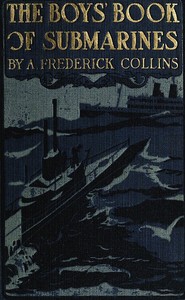
The Boys' Book of Submarines — A Reader’s Guide
(0 User reviews)
1796
Project Gutenberg
2015
Not confirmed
Submarines (Ships) -- Juvenile literature; Submarines (Ships) -- Design and construction -- Juvenile literature; Submarines (Ships) -- Models -- Juvenile literature; Submarine warfare -- Juvenile literature; World War, 1914-1918 -- Naval operations -- Submarine -- Juvenile literature
Readers of public-domain and historical texts
Project Gutenberg digital edition
en
Edition facts
Words
46,014
Reading time
201 min
Text sections
20
The source record for The Boys' Book of Submarines — A Reader’s Guide measures this digital text at 46,014 words, 3 hr 21 min estimated reading time, and 20 detected text sections.
The text analysis averages about 26.2 words per sentence, while the detected sections provide another way to judge how the source is divided.
Project Gutenberg metadata also associates the work with “Submarines (Ships) -- Juvenile literature,” connecting these edition facts with the source record’s subject description.
Source:
Project Gutenberg record #49873
This editorial note examines the structure, recurring images, and scene transitions in 'The Boys' Book of Submarines,' focusing on how the authors balance technical exposition with dramatic wartime context through specific textual evidence.
Read the complete public-domain text at its original source.
Read on Project GutenbergThe opening address, 'A Word to You,' immediately establishes a dual voice: the authors speak directly to the reader as a potential future serviceman, framing submarine warfare as both a technical subject and a matter of national urgency. The phrase 'Submarine! It’s a word that’s in everybody’s mind—on every one’s tongue' sets a tone of immediacy, while the subsequent chapters alternate between historical narrative and mechanical explanation. This structural oscillation mirrors the submarine’s own movement between surface and submerged states, a pattern reinforced by recurring images of diving, surfacing, and concealment.
Structural Alternation Between Narrative and Technical Exposition
The book is organized into twenty text sections that move between historical overview, operational principles, and detailed mechanical descriptions. For instance, the early chapters recount the development of submarines from 1900 onward, while later sections focus on specific components like the spring-action gun. This alternation is not arbitrary: each technical passage is introduced by a narrative hook, such as the claim that 'the greatest war in the world’s history is being fought.' The effect is a pedagogical rhythm that keeps the reader engaged while building a cumulative understanding. The authors frequently use transitional phrases like 'From what has been said above' to link sections, creating a sense of logical progression.
Recurring Images of Diving and Surfacing
Throughout the excerpts, the submarine is repeatedly described in terms of its ability to 'dive like a porpoise' and 'run submerged.' These images are not merely decorative; they structure the authors’ explanations of how the boat operates. The description of the Krupp gun being 'stowed away' in a deck-well and then 'thrown up' by a spring mirrors the submarine’s own cycle of submergence and emergence. Similarly, the phrase 'when a submarine is chased and has no time to dive' underscores the vulnerability of the surface state. This recurring pattern of concealment and revelation becomes a central motif, linking mechanical design to tactical reality.
Movement Between Scenes: From Workshop to Warzone
The authors shift fluidly between the workshop—where inventors 'worked hard to equip their craft'—and the warzone, where submarines 'torpedoed and sent to the bottom of the old ocean.' This movement is achieved through direct address and rhetorical questions, such as 'do you know exactly how an undersea boat works and fights?' The effect is to collapse the distance between the reader’s immediate context and the distant theaters of war. The use of present tense in passages about gun operation ('the gun is mounted on a swinging frame') further blurs the line between description and action, making the technical details feel immediate and consequential.
The Role of Diagrams and Visual Evidence
The text frequently references figures and diagrams, such as 'Fig. 46' and 'Fig. 47,' which illustrate the mounting of submarine guns. These visual aids are integral to the authors’ explanatory method: they do not merely supplement the text but are explicitly invoked as evidence. For example, the description of the Krupp gun’s operation is anchored by the instruction to 'look at Fig. 46,' which shows the gun 'laying on its back' in the well. This reliance on diagrams reflects the book’s pedagogical intent, treating the reader as an apprentice who must learn to read technical drawings. The captions, such as 'A 3½ INCH SUBMARINE GUN IN ACTION,' further reinforce the connection between static image and dynamic operation.
Readers attentive to the book’s structure will notice how the authors use repetition of key phrases—'rapid-fire,' 'quick-action,' 'deck-well'—to build a technical vocabulary. The constant reference to time intervals, such as the gun being raised 'in just 20 seconds,' underscores a preoccupation with efficiency under pressure. These details, rather than broad historical claims, give the work its distinctive character as a manual that is also a piece of wartime propaganda.
There’s a particular hush when I think back on The Boys' Book of Submarines, the way its diagrams of ballast tanks somehow held the same patience as the deep water itself. I found that same quiet fortitude in the pages of Female Warriors, Vol. 1 (of 2) Memorials of Female Valour and Heroism, from the Mythological Ages to the Present Era. — Text and Context, where courage felt less like a shout and more like a steady, measured descent.
There are no reviews for this eBook.
There are no comments for this eBook.
Reader reflection
Record your reading impressions
A brief reflection can help important ideas stay with you longer.
Your progress
0
/
10
2
How much did you enjoy the reading experience?
3
Would you recommend this book to another reader?
4
How demanding did the text feel?
5
How valuable was this book for your own interests?
6
Did this book create an emotional response?
7
How did the pace of the book feel?
8
How distinctive were its ideas or approach?
9
What changed or sharpened your thinking?
10