1

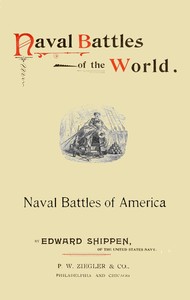
Naval battles of the world — Story, Setting & Ideas
(0 User reviews)
122
Project Gutenberg
2024
Not confirmed
Naval battles; United States. Navy; Sino-Japanese War, 1894-1895
Readers of public-domain and historical texts
Project Gutenberg digital edition
en
Edition facts
Words
262,169
Reading time
1140 min
Text sections
69
For Naval battles of the world — Story, Setting & Ideas, the stored edition analysis reports 262,169 words, 19 hr estimated reading time, and 69 detected text sections.
The text analysis averages about 24.8 words per sentence, while the detected sections provide another way to judge how the source is divided.
Project Gutenberg metadata also associates the work with “Naval battles,” connecting these edition facts with the source record’s subject description.
Source:
Project Gutenberg record #73068
Edward Shippen's 1905 survey of decisive naval engagements, from Salamis to the Yalu, combines technical description of armament with tactical narrative, emphasizing the U.S. Navy's modernization and the brutal mechanics of late-19th-century ship-to-ship combat.
Read the complete public-domain text at its original source.
Read on Project GutenbergEdward Shippen, a U.S. Navy officer, wrote Naval Battles of the World as a popular history intended to demonstrate the necessity of a strong navy, particularly for a nation with coastlines on two oceans. The preface states the book aims to inform readers in inland regions about naval history's value for understanding geography and government. Shippen avoids technical jargon for a general audience but does not shy from precise descriptions of damage, as seen in the account of the Huascar's capture, where he notes shot-holes so jagged that ordinary stoppers could not serve.
A Popular History with a Purpose
Shippen frames his collection as a response to public indifference: when the volume first appeared, some questioned why such a publication was necessary. His answer is that it was meant to inform the central and western United States of the navy's role in world history. The preface argues that commonsense dictates the navy will become the preponderant branch of military force, given the nation's extensive seacoasts. This explicit advocacy shapes the selection of battles and the emphasis on decisive outcomes. The author's voice is that of an insider—he is identified as being of the United States Navy—and his descriptions carry the authority of professional observation, even when recounting ancient conflicts.
The Mechanics of Destruction
The excerpt from the Huascar engagement reveals Shippen's method: he catalogs damage with clinical specificity. The Peruvian ship's upper works are described yard by yard: smoke-stack, conning tower, boats, davits, mast, chain-plates all injured. He notes that the armor was a disadvantage because it caused projectiles to explode, driving fragments inward with deadly effect. Shells that passed through thin sides did not explode and caused little damage. This attention to the physics of naval warfare—the interaction of armor, projectile, and crew—recurs throughout. Shippen also records practical details: the Huascar's log-book was destroyed, but complete working drawings of enemy ships were found aboard.
Voice and Structure in Battle Narrative
Shippen's prose shifts between detached summary and vivid, almost forensic reconstruction. In the Huascar account, he reports that eighteen dead bodies were taken from the cabin and the turret was full of remains of two gun crews. He notes the light wood-work, ladders, and bulkheads were all destroyed. The narrative follows a clear chronology: the action lasted one hour and a half; the Huascar lost her commander and three next senior officers; twenty-eight men killed, forty-eight wounded out of a crew of about two hundred. Yet Shippen also includes moments of human action, such as Lieutenant Simpson boarding with a revolver, and the Peruvian crew waving towels and handkerchiefs to signal surrender.
Diction and the Language of Armament
Shippen's vocabulary reflects his professional background. He uses terms like Palliser shells, Nordenfelt machine gun, conning tower, and hatch-combings without explanation, assuming a reader willing to learn. The preface acknowledges that technicalities have been avoided as far as possible, but that it is often necessary to use the language of those who fought. This creates a texture of authenticity: the reader encounters the material reality of late-19th-century naval combat through the precise naming of weapons and ship parts. The description of the Huascar as a floating target for the Chilian's accurate fire is a rare moment of metaphor; more typical is the enumeration of hits: the Cochrane fired forty-five Palliser shells, the Blanco thirty-one, the Huascar about forty.
Readers approaching Naval Battles of the World should expect a work that balances technical exposition with narrative action, shaped by a clear argument for naval strength. Shippen's voice is that of a knowledgeable advocate, not a neutral chronicler. The excerpts suggest that the book's value lies in its detailed accounts of individual engagements, where the interplay of armor, projectile, and human decision is rendered with precision. Those interested in the material culture of naval warfare or the rhetoric of American expansionism will find much to examine.
I remember first opening that maritime volume, its pages weighed down by ironclads and gunpowder, and yet what lingered was not the clash but the quiet patience of strategy, the waiting before the shot. It reminded me, oddly, of a different kind of patience—the steady, unhurried tread I found in Small Horses in Warfare — A Reader’s Guide. Both speak of duty done quietly, before history’s noise begins.
There are no reviews for this eBook.
There are no comments for this eBook.
Reader reflection
Your personal reading reflection
Build a private reading journal entry for this title.
Your progress
0
/
10
2
What was your overall reaction to the book?
3
Would you pass this book on to a friend?
4
How much effort did this book require?
5
How did the reading compare with what you expected?
6
How strong was your personal connection to the text?
7
How valuable was this book for your own interests?
8
Did the book offer a fresh perspective?
9
What did this book teach you most?
10