1

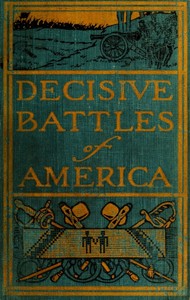
Decisive Battles of America — Inside the Classic
(0 User reviews)
3646
Project Gutenberg
2018
Not confirmed
United States -- History, Military -- To 1900; Battles -- United States
Readers of public-domain and historical texts
Project Gutenberg digital edition
en
Edition facts
Words
121,573
Reading time
529 min
Text sections
30
This digital edition of Decisive Battles of America — Inside the Classic is described by source-level measurements including 121,573 words, 8 hr 49 min estimated reading time, and 30 detected text sections.
The text analysis averages about 20.2 words per sentence, while the detected sections provide another way to judge how the source is divided.
Project Gutenberg metadata also associates the work with “United States -- History, Military -- To 1900,” connecting these edition facts with the source record’s subject description.
Source:
Project Gutenberg record #57899
An editorial note on the authorial choices in Ripley Hitchcock's edited collection of military history, focusing on the varied diction, narrative voice, and descriptive strategies across chapters by different historians.
Read the complete public-domain text at its original source.
Read on Project GutenbergThe editorial hand of Ripley Hitchcock in Decisive Battles of America is most evident in the assembly of voices: the volume draws on historians from different eras and styles, from Richard Hildreth’s mid-nineteenth-century prose to Reuben Gold Thwaites’s turn-of-the-century scholarship. The result is a work where diction and narrative pace shift markedly from chapter to chapter, offering readers a layered experience of American military history.
One striking feature is the use of vivid, almost novelistic description in passages such as the account of the Mexican-American War, where the landscape is rendered with sensory detail: “the city itself glittering in the centre, and bright lakes, grim forts, and busy causeways dotting the dark expanse of marsh and lava.” This choice to embed topographical precision within dramatic narrative is typical of several contributors, who blend factual reporting with a rhetorical urgency that suggests the stakes of each engagement.
Varied Diction Across Contributors
The collection’s multiple authors employ markedly different vocabularies and sentence rhythms. Richard Hildreth, writing on the Pequot War and King Philip’s War, uses a formal, somewhat archaic diction: his sentences are often long and periodic, with clauses that build to a decisive point. In contrast, the chapter on the Mexican-American War (likely by a later contributor) adopts a more direct, almost journalistic style, with shorter sentences and active verbs: “Scott determined to attack on both sides, and sent forward Worth on the east and Pillow and Twiggs on the west.” This variation is not merely stylistic but reflects the evolving conventions of historical writing between the 1840s and the early 1900s.
Another contrast appears in the treatment of Native American forces. Hildreth’s account of the Pequot Conquest uses terms like “savages” and “hostiles,” consistent with his era, while later chapters on the Revolutionary War and the War of 1812 refer to “British regulars” and “American militia” with more neutral terminology. The reader thus encounters a spectrum of authorial attitudes embedded in word choice.
Narrative Voice and Rhetorical Strategy
The editors and authors frequently adopt a commanding narrative voice that assumes the reader’s interest in military strategy and national destiny. In the excerpt on the Mexican-American War, the writer employs dramatic foreshadowing: “With the energy which characterized Santa Anna throughout the war, he had prepared for a desperate defence.” This rhetorical move—characterizing a historical figure with a single trait—is common across the volume. Similarly, the description of the Mexican Congress voting unanimously to forbid negotiations is framed as an act of “constancy equal to anything recorded of the Roman Senate,” a classical allusion that elevates the narrative.
However, the voice is not uniform. Some chapters, such as those by Albert Bushnell Hart, adopt a more analytical tone, summarizing “synopses of the principal events” in a detached manner. Others, like Benson J. Lossing’s account of Bunker Hill, lean into patriotic sentiment. This mix means the reader must adjust expectations from one chapter to the next, a deliberate editorial choice that mirrors the diversity of American historical memory.
Descriptive Precision in Landscape and Fortifications
A recurring authorial choice is the meticulous description of terrain and defensive works. The Mexican-American War chapter provides a detailed catalogue of obstacles: “vast marshes, intersected by ditches and for the most part impassable,” “a field of lava, deemed almost impassable for troops,” and “the formidable castle of Chapultepec.” Such passages serve both to explain military outcomes and to create a sense of place. The writers often use geographical specifics—names of lakes, villages, and causeways—to anchor the narrative in a real, traversable space.
This descriptive strategy is not merely functional. In the account of the Battle of Contreras, the lava field called the Pedregal becomes a character in the story, its broken ground dictating the movement of troops. The writer notes that “infantry alone could advance,” a detail that shapes the tactical decisions described. By foregrounding physical geography, the authors imply that battles are won not only by generalship but by the land itself.
Temporal Framing and the Use of Synopsis
Hitchcock’s editorial structure includes synopses between chapters that summarize “the principal events, chiefly military” between battles. These synopses, written in a compressed, list-like style, contrast sharply with the flowing narratives of the chapters. For example, the synopsis between the Conquest of the Pequots and the Defeat of King Philip covers decades in a few paragraphs, using phrases like “Synopsis of the principal events, chiefly military, between…” This framing device creates a rhythm of expansion and contraction, allowing the reader to move quickly through periods deemed less decisive.
The choice to include these synopses reflects an editorial assumption that the reader values narrative momentum over exhaustive coverage. It also reveals a hierarchy of importance: battles are the focal points, while intervening years are treated as connective tissue. This temporal structure shapes how the reader perceives causality, implying that decisive moments are isolated events rather than gradual processes.
Readers approaching Decisive Battles of America should attend to the shifts in authorial voice as much as to the battles themselves. The volume is a record not only of military history but of how historians have chosen to tell that history—through diction, narrative stance, and descriptive emphasis. Noticing these choices enriches the reading experience and reveals the assumptions each writer brought to the task.
Reading about how Hitchcock let each historian keep their own cadence reminds me of leafing through my uncle’s old navy collection, where the prose shifted like changing seas. A History of Sea Power — A Closer Reading stirred that same quiet ache—not for the battles, but for the voices carrying me through them.
There are no reviews for this eBook.
There are no comments for this eBook.
Reader reflection
How did this book work for you?
Your answers remain private and are stored only in this browser.
Your progress
0
/
10
2
Did this book hold your interest?
3
How likely are you to recommend this book?
4
Did the language feel accessible?
5
How clear did the writing feel?
6
How valuable was this book for your own interests?
7
Did anything about the book feel genuinely new?
8
How did the reading compare with what you expected?
9
Which lesson or insight stayed with you?
10