1

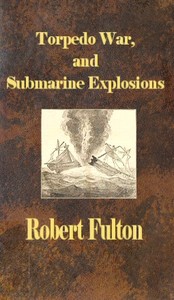
Torpedo War, and Submarine Explosions — Text and Context
(0 User reviews)
737
Project Gutenberg
2016
Not confirmed
Submarine warfare; Torpedoes
Readers of public-domain and historical texts
Project Gutenberg digital edition
en
Edition facts
Words
20,211
Reading time
88 min
Text sections
3
Torpedo War, and Submarine Explosions — Text and Context can be approached with a clearer sense of reading commitment from its source measurements: 20,211 words, 1 hr 28 min estimated reading time, and 3 detected text sections.
The text analysis averages about 34.4 words per sentence, while the detected sections provide another way to judge how the source is divided.
Project Gutenberg metadata also associates the work with “Submarine warfare,” connecting these edition facts with the source record’s subject description.
Source:
Project Gutenberg record #51748
Robert Fulton's 1810 treatise on torpedo warfare combines technical diagrams, tactical calculations, and political argument to advocate for submarine weapons as a means to secure maritime liberty, with precise estimates of boat formations and attack scenarios.
Read the complete public-domain text at its original source.
Read on Project GutenbergRobert Fulton's Torpedo War, and Submarine Explosions (1810) is a meticulously argued treatise that blends engineering detail with strategic vision. The work opens with a dedication to the principle that 'the Liberty of the Sea will be the Happiness of the Earth,' framing its technical proposals within a broader political philosophy. Fulton does not merely describe his inventions; he calculates the precise dimensions of torpedo boats—six feet wide and twenty-seven feet long—and the spacing required to arrange 440 of them side by side in a mile. This attention to spatial logistics recurs throughout, as he estimates the length of a ship of the line at forty fathoms and the distance between vessels at one hundred fathoms, building a quantitative case for the feasibility of small-boat attacks against large fleets.
Recurring Calculations and Spatial Logic
Fulton's argument depends on repeated numerical demonstrations. He computes that a fleet of one hundred 80-gun ships would form a line of 'fourteen thousand fathoms, or twenty-eight thousand yards, equal to near sixteen miles.' He then divides this force into divisions and subdivisions, but insists that conventional tactics become irrelevant when facing torpedo boats. The boats themselves are designed for rapid deployment: each can be drawn onto a beach 'above high water mark' by its twelve-man crew. Fulton estimates that fifty torpedo boats, each with twelve men (totaling six hundred), could force an 80-gun ship with six hundred men to retreat. These calculations are not abstract; they are tied to specific geographic waters, such as the British Channel between Boulogne and Romney, and the narrows from Calais to Dover.
Movement Between Scenes: From the Workshop to the Channel
The text shifts abruptly between technical description and strategic scenario. Early sections detail the construction of torpedoes with 'locks that strike fire by concussion' and 'clockwork locks,' as evidenced in Fulton's 1813 letter included in the preface. Later, he stages a hypothetical battle in the British Channel, where 'the coast of Boulogne be the scene for action.' This movement from workshop to theater is characteristic: Fulton envisions his devices not in isolation but in operation against a defined enemy. He also projects future population growth, noting that his estimate for 1920 'has already been exceeded in fact,' according to the editor's preface. The text thus oscillates between the immediate and the prophetic, grounding each leap in concrete numbers.
The Rhetoric of Inevitability and Moral Justification
Fulton anticipates objections to his invention, devoting a section to 'the imaginary inhumanity of Torpedo war.' He counters by arguing that torpedoes would make war so destructive that nations would avoid conflict altogether, a logic familiar from later deterrence theory. His language is declarative: 'it is impossible to foresee to what degree torpedoes may be improved and rendered useful.' Yet he also hedges, acknowledging that his system 'requires only to be organized and practised.' The editor's preface notes that Fulton's plan for affixing torpedoes by harpoons was designed for wooden ships and became obsolete with ironclads, but his broader claim—that torpedoes would 'produce a change in Maritime affairs of immense importance'—proved prescient. The text thus balances technical caution with sweeping prediction.
Structure as Argument: Diagrams, Estimates, and Appendices
The book's organization mirrors its argumentative strategy. After the main treatise, Fulton includes separate sections: 'Thoughts on the probable effect of this invention,' 'Estimate of the Force to Attack so Formidable a Blockade Fleet,' 'Manner of Arranging the Boats Until Wanted,' and two 'Modes of Attack.' These are not mere appendices but integral to the persuasive structure. The plates (I through V) are referenced in the table of contents and presumably illustrate the torpedo mechanisms and boat formations. The editor's preface, written during World War I, underscores the timeliness of Fulton's ideas, noting that 'only his plan of affixing torpedoes to their prey by means of harpoons seems…fantastic.' This layered structure—original text plus later commentary—invites readers to compare Fulton's predictions with subsequent developments.
Readers approaching Torpedo War, and Submarine Explosions should attend to the interplay between Fulton's technical diagrams and his geopolitical reasoning. The work is not a narrative but a proposal, and its power lies in the specificity of its calculations. The editor's preface provides useful context, but the core text rewards close reading of its numerical claims and spatial arrangements. Fulton's vision of maritime warfare, though rooted in the age of sail, anticipates the submarine conflicts of the twentieth century.
Reading Fulton’s careful calculations about torpedo boats, I felt that odd ache for a time when such plans felt like futures worth fighting for. It reminded me of the quiet, almost lonely patience in Battle Studies; Ancient and Modern Battle — Story, Setting & Ideas, where strategy reads less like glory and more like a long, private conversation with what has passed. Some books just hold that stillness.
There are no reviews for this eBook.
There are no comments for this eBook.
Reader reflection
Your personal reading reflection
Build a private reading journal entry for this title.
Your progress
0
/
10
2
What was your overall reaction to the book?
3
Would you pass this book on to a friend?
4
How easy was the book to follow?
5
Did this book create an emotional response?
6
Did it raise ideas you would like to talk about?
7
Is this a title worth rereading?
8
Was the book what you thought it would be?
9
What changed or sharpened your thinking?
10