1

Secret armies — Themes and Context
(0 User reviews)
1101
Project Gutenberg
2007
Not confirmed
Secret service -- Germany; Propaganda, German; Fascism
Readers of public-domain and historical texts
Project Gutenberg digital edition
en
Edition facts
Words
45,227
Reading time
197 min
Text sections
7
Secret armies — Themes and Context can be approached with a clearer sense of reading commitment from its source measurements: 45,227 words, 3 hr 17 min estimated reading time, and 7 detected text sections.
The text analysis averages about 19.6 words per sentence, while the detected sections provide another way to judge how the source is divided.
Project Gutenberg metadata also associates the work with “Secret service -- Germany,” connecting these edition facts with the source record’s subject description.
Source:
Project Gutenberg record #22682
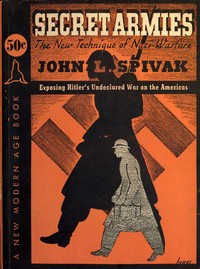
A 1939 exposé of Nazi espionage and propaganda networks in the Americas, based on documents and interviews. Spivak traces secret agents, smuggling operations, and American collaborators, naming specific individuals and organizations.
Read the complete public-domain text at its original source.
Read on Project GutenbergJohn L. Spivak’s Secret Armies (1939) opens with a detailed account of how Nazi secret instructions and spy reports were smuggled off German ships in New York harbor. A steward retrieves a thin package from a closet aboard the liner, passes it to a man named Orgell, who covers it with a newspaper and leaves. The episode is typical of the book’s method: specific names, addresses, and dates are given for each link in the chain. Spivak names Orgell’s liaison, Frank Mutschinski, a painting contractor who commanded an American branch of the Stahlhelm, and notes that Nazi uniforms were smuggled in by Paul Bante, a member of the Coast Guard and National Guard. The excerpts show a journalist working from documents and interviews, not from speculation.
Named Operatives and Their Networks
The excerpts provide a roster of individuals with full addresses and roles. Frank Mutschinski lived at 116 Garland Court, Garritsen Beach, N.Y., and arrived from Germany on the S.S. George Washington in 1920. He received orders from Franz Seldte, later Hitler’s Minister of Labor. Carl Brunkhorst delivered secret letters. Paul Bante, at 186 East 93rd Street, smuggled uniforms while serving in the 244th Coast Guard and New York National Guard. The Stahlhelm had branches in Rochester, Chicago, Philadelphia, Newark, Detroit, Los Angeles, and Toronto. Spivak does not claim these were the only operatives; he presents them as examples of a documented system.
American Collaborators and Racketeering
Spivak describes how Nazi agents cooperated with American “racketeering ‘patriots’” who exploited public fear during the Depression. Harry A. Jung, Honorary General Manager of the American Vigilant Intelligence Federation in Chicago, originally spied on Communists and Socialists for employers. When the promised revolution failed to materialize, Jung switched to anti-Semitism, peddling “the ‘menace of the Jew’” as a new fundraising issue. The excerpts link this directly to the arrival of a German agent named Emerson and the launch of the “Friends of Germany.” Spivak treats these figures as part of a financial pipeline, not just ideological sympathizers.
Documentary Evidence and the Author’s Method
The book’s front matter emphasizes that Spivak’s facts are “unanswerable, uncontradicted” and supported by “original letters and records, citing chapter and verse, naming names, dates and places.” The excerpts include reproductions of letters and handbills, such as an application for the Secret Order of ’76 and a letter from Harry A. Jung. The table of contents shows chapters on specific countries (Czechoslovakia, England, France, Mexico) and on U.S. targets (the Panama Canal, universities, the Dies Committee). Spivak’s style is direct and concrete, avoiding generalization; he lets the documents speak, though the excerpts do not reveal whether he ever interviewed the subjects.
Readers should note that Secret Armies was published in 1939, before the United States entered World War II. The excerpts show a work of investigative journalism that relies on named sources and physical evidence. The book’s claims about Nazi infiltration in the Americas can be compared with later historical scholarship, but the text itself offers a contemporary snapshot of how one reporter documented a covert network. The detailed addresses and organizational affiliations provide a starting point for verifying the networks Spivak describes.
Reading about the secret armies of spies and smugglers made me think of my grandfather’s tales of the sea, and the quiet courage in Storm Warriors; or, Life-Boat Work on the Goodwin Sands — A Reader’s Guide. Both books feel like hidden maps of resilience, one charting hidden wires, the other hidden shoals. I remember feeling that same silent awe—how ordinary people face extraordinary, unseen forces.
There are no reviews for this eBook.
There are no comments for this eBook.
Reader reflection
How did this book work for you?
Your answers remain private and are stored only in this browser.
Your progress
0
/
10
2
Was reading this book enjoyable?
3
Would you recommend this book to another reader?
4
Did the language feel accessible?
5
Would this book work well in a reading group?
6
Did the book offer a fresh perspective?
7
How did the pace of the book feel?
8
How well did it match your expectations?
9
In one sentence, what did you learn?
10