1

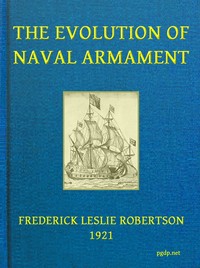
The Evolution of Naval Armament — Key Ideas to Explore
(0 User reviews)
291
Project Gutenberg
2018
Not confirmed
Ordnance, Naval -- History; Warships -- History; Naval art and science -- History
Readers of public-domain and historical texts
Project Gutenberg digital edition
en
Edition facts
Words
125,719
Reading time
547 min
Text sections
23
The source record for The Evolution of Naval Armament — Key Ideas to Explore measures this digital text at 125,719 words, 9 hr 7 min estimated reading time, and 23 detected text sections.
The text analysis averages about 27.2 words per sentence, while the detected sections provide another way to judge how the source is divided.
Project Gutenberg metadata also associates the work with “Ordnance, Naval -- History,” connecting these edition facts with the source record’s subject description.
Source:
Project Gutenberg record #56777
An engineer commander's technical history tracing the interdependent evolution of ships, guns, and engines from the 17th to early 20th century, with emphasis on the revolutionary changes of the 1800s and the interplay between British and French naval material.
Read the complete public-domain text at its original source.
Read on Project GutenbergFrederick Leslie Robertson, an engineer commander in the Royal Navy, structures his study around three interdependent elements: ship, gun, and engine. Rather than treating them in isolation, he repeatedly shows how a change in one forced adaptation in the others. The excerpts reveal a narrative that moves between national contexts—contrasting British caution with French experimentation—and across scales, from the chemistry of combustibles aboard a single ship to the strategic implications of shell-fire trials at Meudon.
Robertson’s preface grounds the work in a specific institutional geography: research conducted “under the lee of the Admiralty library,” close to the Royal United Service Institution and the British Museum. This proximity to primary sources shapes his method, which combines technical description with a historian’s attention to documentary evidence.
A Recurring Pattern: British Caution vs. French Experimentation
Throughout the excerpts, Robertson returns to a contrast between British resistance to change and French willingness to adopt novel materials. He notes that the French “suffered for the precipitancy with which they adopted inflammatory agents,” citing fires and explosions in their fleets. The Orient at the Nile serves as an example: even if not ignited by their own combustibles, the spread of fire was accelerated by the presence of “carcasses, stinkpots, port-fires.” Robertson then observes that the British felt “confirmed and fortified” in their skepticism. Yet he does not present this as a simple moral; the French, under Paixhans, eventually produced a “complete solution of the shell-fire problem.” The pattern recurs in the discussion of shell trials: British practice with mortars and carronades provided groundwork, but the French synthesized existing elements into a new system.
Movement Between Scales: From Chemistry to Strategy
Robertson’s analysis moves fluidly between the microscopic and the strategic. He describes the chemical instability of early shells, then widens to the tactical consequences: “fuzed shells, carcasses, stinkpots, port-fires, proved far more terrible to friend than foe.” A single anecdote—the French accusation that an English captain used shells, only to have the gunner reveal they were found on a captured French ship—illustrates the ethical and practical confusion surrounding new weapons. Later, the narrative shifts to the siege of Acre, where Bonaparte himself was targeted by a 68-pounder carronade from the English fleet. This movement between laboratory, shipboard accident, and battlefield event gives the technical history a dramatic, almost narrative quality.
The Role of the Carronade as a Transitional Weapon
Robertson gives particular attention to the carronade, calling its invention “almost a solution” to the problem of effective ship armament. Though it did not lead directly to the shell gun, it “undoubtedly induced the weapon which most strongly resembled it”: the medium ship-gun designed by Congreve and Blomefield. This weapon was mounted in two-decked ships “for the purpose of preserving unity of calibre.” The carronade thus serves as a pivot in Robertson’s narrative—a British innovation that, while not fully realized, created the conditions for later developments. He contrasts this with the French approach under Paixhans, who “seized on the possibilities of existing elements, and combined them in such a way as to form a complete solution.” The carronade’s story exemplifies Robertson’s interest in the uneven, non-linear path of technological evolution.
The Paixhans System as a Turning Point
Robertson identifies General Paixhans as the figure who synthesized earlier experiments into a coherent system. He cites two key publications—Nouvelle Force Maritime et Artillerie (1822) and Expériences faites sur une Arme Nouvelle (1825)—and notes that Paixhans’s trials extended over several years. The result was a scheme of ship armament that “was to win adoption, in the course of time, in the French navy,” eventually forcing British authorities to abandon their established methods. Robertson’s treatment of Paixhans is notably balanced: he credits the French general with solving the shell-fire problem, but also shows that British practice with mortars and carronades had laid essential groundwork. The section underscores Robertson’s broader argument that naval material evolves through a dialogue between national traditions, not in isolation.
Robertson’s work rewards readers who attend to his structural choices: the alternation between British and French perspectives, the movement from technical detail to strategic consequence, and the recurring image of fire as both tool and hazard. Because the excerpts cover only portions of the text, the full arc of his argument—particularly the treatment of the “Admiral” class battleship as the beginning of the modern navy—remains to be explored. Readers interested in the material culture of naval history will find a methodical, source-based account that bridges the gap between classic histories and modern textbooks.
There’s something about an engineer’s patience with old machinery that stays with you—those quiet hours tracing how guns and hulls grew inseparable. That lingering feeling of watching systems breathe together reminded me of Naval Warfare — Reading Companion, where the same relational thread runs softer, more reflective. It felt like sitting beside an old friend watching the tide, not explaining it.
There are no reviews for this eBook.
There are no comments for this eBook.
Reader reflection
How did this book work for you?
Your answers remain private and are stored only in this browser.
Your progress
0
/
10
2
How did the book work for you overall?
3
How likely are you to recommend this book?
4
Did the language feel accessible?
5
Which aspect of the book did you value most?
6
Did any part of the book feel personally relevant?
7
How original did the book feel?
8
Do you expect to return to this book?
9
What did this book teach you most?
10