1

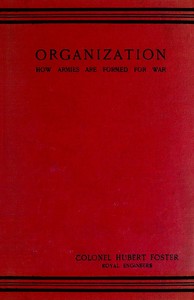
Organization: How Armies are Formed for War — Reading Companion
(0 User reviews)
672
Project Gutenberg
2017
Not confirmed
Armies -- Organization
Readers of public-domain and historical texts
Project Gutenberg digital edition
en
Edition facts
Words
56,624
Reading time
247 min
Text sections
33
The source record for Organization: How Armies are Formed for War — Reading Companion measures this digital text at 56,624 words, 4 hr 7 min estimated reading time, and 33 detected text sections.
The text analysis averages about 20.0 words per sentence, while the detected sections provide another way to judge how the source is divided.
Project Gutenberg metadata also associates the work with “Armies -- Organization,” connecting these edition facts with the source record’s subject description.
Source:
Project Gutenberg record #54859
Colonel Hubert Foster's 1911 treatise on army organization examines the principles and structures of command, communication, and logistics, with a focus on British and European systems, drawing on historical development and contemporary practice.
Read the complete public-domain text at its original source.
Read on Project GutenbergColonel Hubert Foster opens his 1911 study by lamenting the lack of a systematic account of army organization, noting that military writers often assume prior knowledge. He distinguishes his work from broader interpretations that conflate organization with tactics, staff duties, and administration, instead adopting a literal and limited sense of the term. The book aims to outline the psychological principles underlying command and to describe the structures that facilitate it, drawing on modern armies in general and the British Army in particular.
Foster structures his work in parts, with Part II detailing British organization and Part IV offering a historical sketch. He avoids minute detail, intending the book for military readers across the Empire as well as general students of history.
Defining the Scope of Organization
Foster explicitly narrows his subject, rejecting the expansive definition that includes “the raising of men, their physical and moral improvement ... their education and training.” Instead, he treats organization as the structure of command and the arrangement of units, deliberately excluding tactics and administration. This focus allows him to examine the chain of command, the composition of divisions and brigades, and the principles of communication and logistics without digression. He criticizes the “almost universal organization of Infantry in foreign armies in Army Corps of 2 Divisions, Divisions of 2 Brigades, and Brigades of 2 Regiments” as faulty, praising the British divisional organization as superior. This comparative approach recurs throughout the text, with Foster frequently contrasting British practice with that of other powers.
Communication as a Structural Principle
Foster devotes considerable attention to inter-communication, describing the “Communication Units” that ensure effective links between commanders and their forces. He notes that “all means of Communication, whether by telegraph, wireless, telephone, day and night signalling, or despatch riders, should be under one organization.” This integration is presented as a modern necessity due to “the wider dispersion of the troops.” He claims that “in no other army is the Telegraph system so completely organized, while Signalling is but little developed outside England.” The emphasis on communication reflects a broader concern with command efficiency, and Foster details how each echelon—from army to brigade—is provided with integral communication assets, including trained regimental signallers at the front.
Lines of Communication and Administrative Separation
A distinctive feature Foster highlights is the British separation of duties on the Lines of Communication into two independent branches: protection and administration. This leaves the Inspector-General of Lines of Communication free to concentrate on the vital matter of supply and movement. He notes that the organization of the Lines of Communication has been remodelled, with “necessary Staffs allotted to the Base, Railhead, Advanced Depôts, and smaller posts” to prevent improvisation in war. The administrative services—medical, transport, and supply—are elaborated in detail. Foster argues that the close union of transport and supply in the British system is superior to foreign armies where transport is a combatant unit and supply a civil department. He also emphasizes the role of railways, noting that “the personnel required for working railways in war has been carefully thought out, and organized in great detail.”
Finance, Clerical Work, and Reinforcements
Foster addresses the financial and clerical burdens of a field army, stating that “the financial difficulties met by an Army in the Field have been faced, and the C.-in-C. relieved from responsibility for them.” An establishment of personnel for accounts and audit is stationed at the base, and a Base Records Office handles clerical work to relieve fighting units. He also notes the provision of a complete Postal Service for the first time in the War Organization. On reinforcements, Foster mentions that each unit mobilizes with its “First Reinforcements,” a system designed to maintain unit strength. These details illustrate his concern with the administrative underpinnings that enable an army to function in the field, reflecting his systematic approach to organization as a whole.
Foster’s work is a product of its time—1911, on the eve of major conflicts—and reflects a professional officer’s effort to codify principles often left implicit. Readers should approach it as a contemporary document that reveals how military thinkers understood command structures, communication, and logistics before the First World War. The book’s value lies not in predicting future warfare but in documenting the assumptions and debates of its era.
Foster’s meticulous diagrams of brigades and supply lines left me strangely wistful. All that careful order, designed to hold chaos at bay. Yet the human element always slips through the gaps, doesn’t it? That’s what surfaced when I later picked up The Defence of Duffer's Drift — Reading Companion. It felt like the same problem, told softly from the muddy ground instead of the map room.
There are no reviews for this eBook.
There are no comments for this eBook.
Reader reflection
How will you remember this book?
Save your reaction, strongest insight, and memorable passage.
Your progress
0
/
10
2
How much did you enjoy the reading experience?
3
Would you recommend this book to another reader?
4
Did the language feel accessible?
5
Did it raise ideas you would like to talk about?
6
Was the book what you thought it would be?
7
Would you read this book again?
8
What was its emotional impact?
9
What did this book teach you most?
10