1

Notes on Training for Rifle Fire in Trench Warfare — Story, Setting & Ideas
(0 User reviews)
2237
Project Gutenberg
2019
Not confirmed
Intrenchments; Siege warfare; Defensive (Military science); Offensive (Military science); Shooting, Military
Readers of public-domain and historical texts
Project Gutenberg digital edition
en
Edition facts
Words
7,500
Reading time
33 min
Text sections
2
The catalog record for Notes on Training for Rifle Fire in Trench Warfare — Story, Setting & Ideas provides practical reading context through 7,500 words, 33 min estimated reading time, and 2 detected text sections.
The text analysis averages about 21.4 words per sentence, while the detected sections provide another way to judge how the source is divided.
Project Gutenberg metadata also associates the work with “Intrenchments,” connecting these edition facts with the source record’s subject description.
Source:
Project Gutenberg record #61058
A 1917 U.S. Army manual on trench rifle fire, emphasizing individual aimed fire up to 400 yards and target-description systems using clock-face methods, compiled from foreign reports for officer training.
Read the complete public-domain text at its original source.
Read on Project GutenbergThe manual opens by distinguishing itself from standard Small Arms Firing Manuals, stating it aims to supplement rather than supersede them. It immediately identifies two core features: the importance of individual aimed fire up to 400 yards in trench conditions, and the need for effective target-description methods. The text frames these as lessons from the Western Front, where sniping had become a highly technical service.
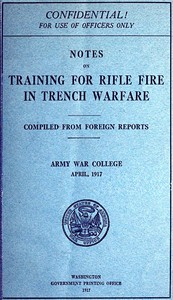
The document is marked CONFIDENTIAL! FOR USE OF OFFICERS ONLY and bears a War Department publication date of April 1917, placing it at the moment of U.S. entry into World War I. Its structure moves from general principles to detailed instructional procedures, including clock-face systems and range estimation techniques.
Individual Aimed Fire and Sniping
The manual stresses that trench warfare elevates the importance of the individual rifleman's aimed fire, particularly under 400 yards. It notes that this practice, termed sniping in Europe, corresponds to what the U.S. calls sharpshooting. The text does not provide a complete sniping curriculum but focuses on the underlying principle: precise, individual fire rather than volley fire. This emphasis is a direct response to the static, close-range conditions of trench fighting, where targets appear briefly and at short distances.
The manual cautions that its instructions are not meant to replace existing training but to highlight aspects undervalued in pre-war doctrine. It references the School of Musketry's prior work on target description, indicating an institutional recognition of the issue before the war.
Target Description Systems
A significant portion of the manual is devoted to target-description methods, using horizontal and vertical clock-face systems. The horizontal system places the observer at the center of a clock dial, with 12 o'clock perpendicular to the firing line. The vertical system uses a reference point as the dial center. The manual provides examples: for instance, announcing 'Target 2 o'clock, a hostile patrol, range 1,000.' It warns against combining both systems unnecessarily, advocating simplicity.
Instruction includes drills where recruits extend arms to indicate clock hours and use finger widths or the rifle's rear sight leaf as angular units for lateral distance. This practical, hands-on training reflects the manual's aim to produce immediate battlefield utility.
Range Estimation and Visual Aids
The manual includes techniques for estimating range using the angle subtended by a finger or the rear sight leaf at arm's length, noting that one finger width corresponds to 50 yards at 1,000 yards. It also describes a captured German fixed rifle rest for firing through loopholes, illustrated with a sketch. This device allowed both lateral and horizontal movement and could clamp the rifle firmly once aimed.
The text treats range estimation as a skill to be drilled, with recruits required to name objects and measure distances in units. The inclusion of captured enemy equipment underscores the manual's basis in foreign reports and practical adaptation.
Structure and Intended Use
The manual is organized into numbered paragraphs, beginning with general training principles and progressing to specific target-description cases. It uses a mix of explanatory text, examples, and procedural steps. The final sections include a sketch and tables for clock-face systems, though the excerpts cut off before the end. The document is clearly intended for officers conducting training, not for individual soldiers, as indicated by its confidential marking and reference to 'recruits' being instructed.
The manual's brevity—around 7,500 words—suggests a focused supplement rather than a comprehensive treatise. Its language is direct and instructional, avoiding theoretical discussion.
Readers should approach this manual as a historical artifact of military training at a specific moment. Its emphasis on individual marksmanship and systematic target description reflects the tactical challenges of World War I trench warfare. The clock-face systems, while seemingly simple, represent a formalized response to the chaos of the battlefield. The manual's limited scope—it does not cover bayonet training or collective fire—makes it a focused, practical document for its intended audience of officers.
I kept thinking about that old manual's strange, quiet insistence on the dignity of careful aim—how it treats a distant target as if it deserved respect. It made me remember something from Blue Shirt and Khaki: A Comparison — Inside the Classic, where clothing becomes a similar kind of attention. Both feel less like history and more like a slow, steady voice that stayed with me long after.
There are no reviews for this eBook.
There are no comments for this eBook.
Reader reflection
What did you think of this book?
Answer a few questions and save a private reflection on this device.
Your progress
0
/
10
2
How did the book work for you overall?
3
Would you recommend this book to another reader?
4
How demanding did the text feel?
5
Which aspect of the book did you value most?
6
Would a second reading be valuable?
7
How distinctive were its ideas or approach?
8
How did the reading compare with what you expected?
9
What did this book teach you most?
10