1

Champions of the fleet — Text and Context
(0 User reviews)
1943
Project Gutenberg
2021
Not confirmed
Great Britain -- History, Naval; Naval battles -- Great Britain
Readers of public-domain and historical texts
Project Gutenberg digital edition
en
Edition facts
Words
81,547
Reading time
355 min
Text sections
20
For Champions of the fleet — Text and Context, the stored edition analysis reports 81,547 words, 5 hr 55 min estimated reading time, and 20 detected text sections.
The text analysis averages about 23.7 words per sentence, while the detected sections provide another way to judge how the source is divided.
Project Gutenberg metadata also associates the work with “Great Britain -- History, Naval,” connecting these edition facts with the source record’s subject description.
Source:
Project Gutenberg record #65978
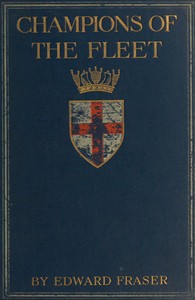
Edward Fraser's 1908 naval history traces the lineage of famous British warship names—Dreadnought, Téméraire, Victory—through specific battles and commanders, using archival records and ship-to-ship comparisons to link the Age of Sail with the early dreadnought era.
Read the complete public-domain text at its original source.
Read on Project GutenbergEdward Fraser opens Champions of the Fleet not with a battle but with a ship name: Dreadnought. The preface immediately establishes the book’s method—tracing how a single vessel’s moniker passes from Drake’s era to Boscawen, Collingwood, and the all-big-gun battleship of 1906. Fraser’s interest lies in continuity: the same name, different hulls, different centuries. He juxtaposes the Victory at Portsmouth with torpedo boats and thirty-knot destroyers, forcing the reader to hold two navies in mind at once. The book is structured as a series of linked narratives, each anchored to a ship or captain, moving chronologically from the Seven Years’ War through Trafalgar and beyond. Fraser relies on Admiralty records, ship dimensions, and muster lists—he notes, for example, exactly where Nelson’s crew came from, county by county. The result is a work of naval genealogy, not just glory.
Ship Names as Historical Threads
Fraser treats the names of men-of-war as living records. The Dreadnought, he explains, served under Drake against the Armada, with Sir Walter Raleigh, against De Ruyter, at La Hogue, and later gave Boscawen his nickname “Old Dreadnought.” He traces the Téméraire—immortalized by Turner and Trafalgar—to its first appearance on the British navy list. The Victory itself is a direct link to George II’s reign: Anson and Boscawen signed the order to lay her keel. Fraser does not merely list battles; he shows how a name accumulates meaning across decades. He notes that the Asia, still at Portsmouth in 1908, was launched thirteen years after the Victory retired. These connections give the book a layered, almost archaeological quality—each ship name is a palimpsest.
The Victory as a Time Machine
One of the book’s most striking passages places the reader on Portsmouth Hard in 1758, watching the French prize Monarque moored where the Victory would later lie. Fraser then cuts to a Norfolk parsonage where a sickly infant—Horatio Nelson—has just been baptized privately. The juxtaposition is deliberate: the ship and the man are born in the same year, but the reader knows their fates will converge. Fraser uses the Victory as a fixed point, measuring change around her. He describes modern torpedo boats, destroyers with twelve-pounders, and a battleship that can drop shells into a tennis-court-sized target at eight thousand yards. The contrast is not merely technological; it is about scale and speed. The Victory’s lifetime, Fraser argues, covers a wider gap than the years suggest.
Forgotten Naval Contributions to Empire
Fraser devotes attention to episodes he believes are underappreciated, particularly the navy’s role in Clive’s Indian campaigns. He argues that without naval support on the battlefield, Clive would have been powerless at Plassey. The book’s subtitle—“Days That Helped to Make the Empire”—signals this corrective intent. Fraser does not simply celebrate; he repositions. He also recounts how the Victory was built amid fears of incendiarism, and how she was safely launched despite sabotage threats. These details—drawn from Admiralty correspondence and shipyard records—ground the narrative in material reality. The navy, for Fraser, is not a backdrop but an active, often decisive, force in imperial history.
Movement Between Eras and Waters
The book’s structure is not strictly chronological. Fraser moves from the Dreadnought’s Elizabethan origins to the 1906 battleship, then back to the Victory’s construction, then forward to Trafalgar. Each chapter is a self-contained “cruise in rather out-of-the-way waters,” as he puts it in the preface. The effect is kaleidoscopic: the reader encounters the same ship name in different centuries, the same battle from different angles. Fraser frequently shifts from the global—the founding of empire—to the intimate: the sickly infant Nelson, the county origins of Trafalgar crewmen. This movement between scales keeps the prose from becoming a dry catalogue. He also uses illustrations—nineteen of them—and notes that some images are clickable for larger versions, a nod to the digital edition’s affordances.
Fraser’s method rewards readers who attend to dates and ship names. The book is best approached not as a continuous narrative but as a series of interlocking case studies. Pay attention to the prefaces and footnotes: Fraser often signals which episodes he considers neglected. The comparisons between old and new warships are not decorative; they are arguments about continuity. For those interested in how naval tradition is constructed—through names, records, and selective memory—Champions of the Fleet offers a rich, if episodic, source.
Reading about the Téméraire brought back an afternoon in my grandfather’s study, the smell of old paper and pipe smoke while he traced ship names for me. It wasn’t the battles that stayed, but the feeling of continuity, of names carrying weight. The Navy as a Fighting Machine — Story, Setting & Ideas once gave me that same quiet sense, of machinery and men bound together across decades. A calm, steady echo.
There are no reviews for this eBook.
There are no comments for this eBook.
Reader reflection
How will you remember this book?
Save your reaction, strongest insight, and memorable passage.
Your progress
0
/
10
2
How did the book work for you overall?
3
Would you pass this book on to a friend?
4
Did the language feel accessible?
5
Was the book what you thought it would be?
6
Which part made the strongest impression?
7
Could you see yourself revisiting this book?
8
Would you like to discuss this book with someone?
9
What did this book teach you most?
10