1

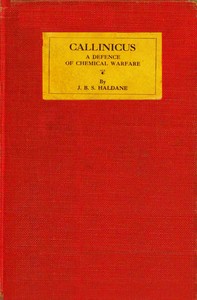
Callinicus — Key Ideas to Explore
(0 User reviews)
1964
Project Gutenberg
2024
Not confirmed
Gases, Asphyxiating and poisonous -- War use; Chemical warfare
Readers of public-domain and historical texts
Project Gutenberg digital edition
en
Edition facts
Words
13,826
Reading time
61 min
Text sections
5
The source record for Callinicus — Key Ideas to Explore measures this digital text at 13,826 words, 1 hr 1 min estimated reading time, and 5 detected text sections.
The text analysis averages about 23.6 words per sentence, while the detected sections provide another way to judge how the source is divided.
Project Gutenberg metadata also associates the work with “Gases, Asphyxiating and poisonous -- War use,” connecting these edition facts with the source record’s subject description.
Source:
Project Gutenberg record #73730
J. B. S. Haldane's 1925 polemic argues for chemical warfare's humanity and efficiency, using scientific reasoning, historical examples, and sharp satire to counter public opinion shaped by wartime propaganda.
Read the complete public-domain text at its original source.
Read on Project GutenbergJ. B. S. Haldane opens Callinicus by positioning himself as a partial witness: a chemist who cannot be expected to be impartial about chemistry, just as a clergyman cannot about religion. This frank admission sets the tone for a work that blends scientific argument with rhetorical provocation. The book, part of the To-day and To-morrow series, is subtitled “A Defence of Chemical Warfare,” and Haldane wastes no time in challenging both pacifist and traditional military viewpoints. He dismisses the notion that gas is uniquely cruel, instead arguing that it is more humane than high explosives and that opposition to it stems from irrational prejudice rather than evidence.
The Rhetoric of Impartiality
Haldane’s authorial voice is carefully constructed to appear reasonable while advancing a controversial thesis. He admits his bias early, then proceeds to adopt a tone of scientific detachment, using calculations and historical examples to support his claims. For instance, he corrects a decimal-point error in a calculation about poisoning London, noting that ten aeroplanes would actually require ten thousand to do the damage claimed. This move serves to position him as a corrective to popular hysteria. At the same time, he employs sarcasm, as when he refers to the Turkish army’s “gentlemanly character” in killing prisoners, contrasting their non-use of gas with their other wartime actions. The effect is a layered argument that appeals to both reason and emotion, often within the same paragraph.
Gas as a Civilizing Force
Central to Haldane’s case is the claim that chemical warfare would make war “less expensive of life and property, shorter, and more dependent on brains rather than numbers.” He supports this with a specific example: the German mustard gas bombardment of the Cambrai salient in March 1918, which caused 4,500 casualties but only fifty deaths, all due to premature removal of respirators. He contrasts this with the high death toll from conventional weapons. Haldane also argues that gas warfare demands organization and discipline, qualities he associates with civilized armies, whereas traditional warfare can be conducted by “small groups” fighting well without such coordination. This inversion of common moral assumptions is a key rhetorical strategy throughout the text.
Satire and the Anti-Gas Mask Industry
Haldane reserves particular scorn for the civilian panic over gas bombs, which he illustrates with the story of London pharmacists selling anti-gas masks that “inspired such faith” that soldiers at the front wore them and died. He compares these masks to “amulets and other pious frauds sold in the name of religion,” a simile that underscores his view of the public as gullible and unscientific. The passage is notable for its vivid detail: the masks had “a better finish than the official pattern and looked like one’s idea of what a gas-mask ought to be.” Here, Haldane uses material culture—the appearance of the masks—to critique the gap between perception and reality, a theme that recurs in his treatment of propaganda and public opinion.
The Limits of the Argument
While Haldane’s prose is confident, the excerpts reveal gaps in his reasoning that the full text may or may not address. He acknowledges that his audience includes both pacifists and those who see war as “a noble occupation,” but he does not engage deeply with the moral case against all war. His focus is on comparative harm: gas is better than explosives, not whether war itself is justifiable. Similarly, his historical examples are selective; the Turkish atrocities he cites are used to discredit the “gentlemanly” ideal, but he does not examine whether chemical weapons might be used by less disciplined forces. Readers should note that the argument is framed as a defence, not an objective analysis, and that Haldane’s scientific authority is deployed in service of a predetermined conclusion.
Callinicus is best approached as a period piece of scientific advocacy, revealing how a prominent biologist sought to shape public policy in the aftermath of the Great War. Haldane’s blend of data, sarcasm, and moral inversion makes the book a fascinating document of its time, but its claims should be weighed against the historical record of chemical warfare’s actual effects. Readers interested in the rhetoric of science or the history of arms control will find much to analyze in its pages.
There’s something oddly tender about Haldane’s old argument for chemical warfare—his faith that reason could clean up humanity’s messiest instincts. It reminds me of sitting with Callinicus and then drifting to Fighting Instructions, 1530-1816 Publications of the Navy Records Society Vol. XXIX. — A Reader’s Guide, those centuries of rigid naval codes, so certain and so fragile. Both feel like letters from a world that still believed order could outlast the chaos.
There are no reviews for this eBook.
There are no comments for this eBook.
Reader reflection
How did this book work for you?
Your answers remain private and are stored only in this browser.
Your progress
0
/
10
2
Did this book hold your interest?
3
Would you encourage someone else to read it?
4
Did the language feel accessible?
5
Did this book create an emotional response?
6
How would you rate its originality?
7
Would you start a conversation about this book?
8
How well did it match your expectations?
9
What did this book teach you most?
10