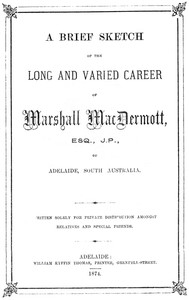
A Brief Sketch of the Long and Varied Career of Marshall MacDermott, Esq., J.P. of Adelaide, South Australia — Context and Discussion
Edition facts
Marshall MacDermott begins his memoir by acknowledging that he wrote it "under a degree of pressure from some members of my family" and without any memoranda, relying entirely on memory. This frank admission sets the tone for a narrative that is personal and unpolished, intended for private circulation among relatives and friends. The opening pages plunge the reader into the year 1808, when MacDermott obtained a commission in the army of King George III and promptly sought foreign service, joining the 1st Battalion of the 8th Regiment at Halifax, Nova Scotia.
The early passages are dominated by a vivid account of a "white squall" encountered during the voyage from Halifax to the West Indies. MacDermott describes the sea as "smooth as a table, but covered with a dense white foam" and the sudden fury that threw the fleet onto its beam ends. This detailed, sensory recollection—sails torn to ribbons, ships jammed together—exemplifies the memoir's strength: a sharp eye for dramatic incident, even as the author admits the fallibility of his memory.
Memory as the Sole Source
MacDermott is candid about the limitations of his account. He states that he "possessed no memoranda whatever" and has "had to rely entirely upon memory; therefore errors in details may reasonably claim excuse, after the lapse of so long a period of time." This disclaimer is not merely a rhetorical gesture; it shapes the texture of the narrative. Dates are often vague, and the sequence of events can feel associative rather than strictly chronological. For instance, the transition from the West Indies to later postings is abrupt, with little connective tissue. The reader is thus invited to read not for precise historical record but for the author's personal impressions and the incidents that have stuck with him across decades. The memoir's title itself—"A Brief Sketch"—underscores this selective, impressionistic quality.
Encounters with the Famous and the Ordinary
One of the most striking passages involves Lord Byron. MacDermott recounts attending a lecture on the "Evidences of Christianity" given by Dr. Kennedy in Cephalonia, with Byron present. Byron, he notes, "did not believe, however, in prophecy, in miracles, or in the inspiration of the Holy Scriptures" and withdrew after the third lecture, complimenting Kennedy as "the most gentleman-like Christian with whom he had ever held a discussion." MacDermott also claims that Byron entrusted him with the manuscript of the last three cantos of Don Juan to deliver to Sir John Cam Hobhouse, and that a brass bedstead MacDermott gave Byron was the one on which Byron died at Missolonghi. These details are presented without fanfare, as if such encounters were routine. The memoir also includes less famous but equally vivid figures: an old brother officer whom MacDermott persuaded to dine with him instead of boarding his ship—a ship that later "parted in two at the water-line" during the great storm at Plymouth.
Storms, Shipwrecks, and Scientific Marvels
MacDermott has a particular eye for dramatic natural events and technological wonders. The white squall of 1808 is described with cinematic detail: "Sails were torn into ribbons and small spars and wreck were flying in all directions." Later, the great storm at Plymouth in 1826 is rendered with similar intensity: "At one spot eight ships were so jammed together that it was difficult to distinguish the wreck of one from the other." Interspersed with these disasters are accounts of scientific achievements, such as the Ordnance Survey of Ireland, where a base line eight miles long was constructed using "a combination of different metals, sliding in grooves" to account for expansion and contraction. MacDermott also notes Mr. Drummond's discovery of the "celebrated light named after him," which allowed bearings to be taken from a distance of 150 miles. These passages reveal a mind curious about both the destructive power of nature and the ingenuity of human engineering.
The Private Purpose and Its Effect on the Narrative
Because the memoir was "written solely for private distribution amongst relatives and special friends," MacDermott assumes a familiar audience. He does not explain who Lord Hutchinson is or why his influence mattered; he does not gloss the significance of the 8th Regiment's movements. This can make the narrative feel elliptical to an outside reader, but it also lends an authenticity of voice. The author is not performing for posterity but recollecting for people who already share much of his context. The result is a work that feels intimate and unguarded, where the writer's priorities—a dramatic storm, a brush with Byron, a scientific marvel—are laid bare without the mediation of a professional biographer. Readers should approach this sketch as a personal document, valuing its immediacy over its completeness.
MacDermott's memoir rewards a patient reading that accepts its gaps and digressions. The narrative moves from the West Indies to Cephalonia to Plymouth to Glasgow, held together not by a central argument but by the author's distinctive voice and his eye for the remarkable. For those interested in the texture of a soldier's life in the early nineteenth century—or in firsthand glimpses of figures like Lord Byron—this brief sketch offers a singular, unvarnished perspective. Read it as a conversation across time, not as a definitive history.