
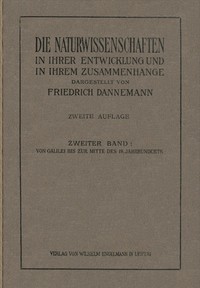
Die Naturwissenschaften in ihrer Entwicklung und in ihrem Zusammenhange, II.…
Forget the dry, intimidating title. This book is a map of human discovery. Friedrich Dannemann, writing in the 1920s, wasn't interested in just listing scientific facts. He wanted to show how they all grew from each other.
The Story
There isn't a plot with characters, but there is a clear narrative. Dannemann takes you on a journey through time, showing how scientific thought evolved. He starts with the big questions people asked centuries ago and follows the threads of those answers. You see how the invention of the telescope didn't just improve astronomy; it changed our entire concept of the universe. You learn how understanding gases led to breakthroughs in both chemistry and medicine. The 'story' is the slow, collaborative, and often messy process of building knowledge, piece by connected piece.
Why You Should Read It
This book changed how I think about science. Today, we often learn subjects in isolation—biology class here, physics class there. Dannemann shows that this separation is artificial. Reading his work, you get a sense of the grand, interconnected adventure of science. It makes the history feel alive and relevant, not just a list of dates and names. It's a reminder that every modern discovery stands on the shoulders of countless earlier ideas from different fields.
Final Verdict
This is a book for the curious general reader who feels that 'science' is a collection of siloed subjects. It's perfect for history buffs, lifelong learners, or anyone who has asked, 'But how does this all connect?' Be warned: it's a translated, century-old academic text, so the prose isn't breezy. But the central idea—seeing the unity in scientific progress—is incredibly powerful and well worth the thoughtful read.
This title is part of the public domain archive. Share knowledge freely with the world.
Kevin Garcia
1 year agoSimply put, it provides a comprehensive overview perfect for everyone. A valuable addition to my collection.
Anthony Sanchez
3 months agoThe layout is very easy on the eyes.
Sarah Nguyen
1 year agoSimply put, the flow of the text seems very fluid. Worth every second.
Elijah Martinez
1 year agoI started reading out of curiosity and the depth of research presented here is truly commendable. I couldn't put it down.


Matthew Thompson
1 year agoUsed this for my thesis, incredibly useful.